Showing posts with label Ephesians 4:32. Show all posts

Sunday, September 25, 2016

The Necessary Art of Forgiveness

Then Peter came to him and asked, “Lord, how often should I forgive someone who sins against me? Seven times?”  “No, not seven times,” Jesus replied, “but seventy times seven!  “Therefore, the Kingdom of Heaven can be compared to a king who decided to bring his accounts up to date with servants who had borrowed money from him.  In the process, one of his debtors was brought in who owed him millions of dollars.  He couldn’t pay, so his master ordered that he be sold—along with his wife, his children, and everything he owned—to pay the debt.  “But the man fell down before his master and begged him, ‘Please, be patient with me, and I will pay it all.’  Then his master was filled with pity for him, and he released him and forgave his debt.  “But when the man left the king, he went to a fellow servant who owed him a few thousand dollars.  He grabbed him by the throat and demanded instant payment.  “His fellow servant fell down before him and begged for a little more time.   ‘Be patient with me, and I will pay it,’ he pleaded.  But his creditor wouldn’t wait.  He had the man arrested and put in prison until the debt could be paid in full.  “When some of the other servants saw this, they were very upset.  They went to the king and told him everything that had happened.   Then the king called in the man he had forgiven and said, ‘You evil servant!  I forgave you that tremendous debt because you pleaded with me.  Shouldn’t you have mercy on your fellow servant, just as I had mercy on you?’  Then the angry king sent the man to prison to be tortured until he had paid his entire debt.  “That’s what my heavenly Father will do to you if you refuse to forgive your brothers and sisters from your heart.”  Matthew 18:21-35(NLT)
Forgiveness is at the heart of the Gospel of Jesus Christ.  A Christmas card I once received had this paragraph:
"If our greatest need had been information, God would have sent us an educator.  If our greatest need had been technology, God would have sent us a scientist.  If our greatest need had been money, God would have sent us an economist.  But since our greatest need was forgiveness, God sent us a Savior."
There are countless examples of forgiveness in the Old Testament.  Esau forgave his tricky brother, Jacob.  Joseph forgave his nasty brothers who sold him into slavery.  In the New Testament, the Gospel is replete with forgiving.  Jesus forgave sins – he forgave Judas in advance – he forgave his executioners from the cross – he forgave Peter for his denial.
Where does forgiveness start?  The dictionary defines forgiveness as: 
to grant pardon, to cease to blame, to cease feeling resentment towards.
Those are verbal descriptions of what happens when forgiveness is given; however, it doesn't answer the question about where forgiveness begins.  The Bible answers forthrightly (as with every other important question of life), that forgiveness begins in the heart. 
The Jews, God's very special people, were used to write almost our entire Bible.  In Jewish thought the human heart is the hidden spring of the personal life
In the Jewish wisdom library we find the Book of Proverbs, 30 chapters of the collected wit, lore and God-inspired thought of the race.  In those thirty chapters are more than eighty references to the heart as the center of living.
The Jewish concept of the heart is organized into three fields:
Reason or logic is our sense of understanding.  In Western thought we say it is the mind.  It is where intelligent creatures separate from the animal kingdom.  Problem-solving is a matter of the heart.
Emotion is the visceral announcement of the heart's condition and desires.  Much of our lives revolve around such emotions as love, anger, compassion, self-preserving instincts or emotions.
Will or moral choice is the place of the soul. 
·       Reason corresponds to the mental, or spirit capacity. 
·       Emotion corresponds to the body, and the
·       Will is the soulish part of us that makes moral decisions of right and wrong.
When we understand the different concepts of the heart of humans, (reason, emotion, will), it is then much easier to understand that, for the heart to truly forgive, all three must be involved.  It is the surrender of the total, threefold heart.

Surrender of Reason

In our parable the king knew that the debt was not payable.  There was no satisfying such a great sum ($10 million).  The Hatfields and McCoys felt the same way.  The 1880's newspapers were filled with accounts of this family feud.  Nobody seems able to recall how the thing got started.  Reports are that it was either Metaphysical and Philosophical divergence on the Civil War postures, or it was hog stealing.  Either way, nearly 100 men women and children died.  It didn't make a lot of sense.  There was no surrender to reason. 
In 1976 Jim McCoy and Willis Hatfield – the last two survivors who took part in the fighting – shook hands at a public ceremony to dedicate a memorial to the victims.  McCoy died at 99 years old in 1984.  His burial was conducted at the Hatfield Funeral Home in Toler, KY.[ii]
Christian reasoning is different from the worldly reasoning; the Bible tells us to be different.  The world sees unilateral forgiveness as a refreshing exception.  In the Kingdom of God it is the living, breathing norm!
The surrender of our reason means allowing our thinking/mind to be controlled and governed by God's Word.  There are several components to surrendering our “reason”:
Response to the command of Jesus 
   (seventy times seven)
Peter knew the Jewish rule; forgive a wrong once, twice, three times, then take revenge.  He thought he was being magnanimous by more than doubling it to seven times.  Jesus told him to forget his scorecard, and just forgive.  We are also commanded to forgive like that.
Reconciliation   
And God has given us this task of reconciling people to him. 
2 Corinthians 5:18(NLT)
Our business as the church is the ministry of reconciling people to Christ.  We cannot imagine to even begin to talk of reconciling others to a God we cannot see if we cannot forgive and be reconciled to the brothers we can see. 
A lack of forgiveness hampers the work of the Holy Spirit of God in us.  There are some things that do not break our fellowship – these hardly need to be considered.  However, if there is something that continually eats away at your insides, it must be dealt with.  A good rule of thumb is:  Anything that can't be forgotten is probably not forgiven either!  It must be driven from your relationship with your Christian brother or sister in open, face-to-face reconciliation.
Restoration 
There will be no mercy for those who have not shown mercy to others. But if you have been merciful, God will be merciful when he judges you.  James 2:13(NLT)
Surrendering our reason means allowing God to have final say in our thinking process. 
In our text, the unjust steward, who wouldn't forgive his fellow servant who only owed him $20, didn't reason well.  He had been forgiven much; he wouldn't forgive even a little. 
We have always heard how the Father's love is unconditional; this is not the case with His forgiveness.  When we refuse to forgive, we refuse to be forgiven.  A dear friend of mine said to me recently that forgiving others is the hard part of that!  Uh…yeah!
A preacher wrote, Can you humbly beseech God, and with tearful eyes look up to Him for pardon while you have your foot upon your brother's neck or your hand at his throat?"[iii]

Surrender of Emotions

The text says the servant's master took pity (had compassion) on him.  It is not easy to surrender your emotions, especially when you believe you've been wronged or hurt.  It is perhaps the most difficult part of forgiveness to place yourself in the other person's shoes, and feel his pain.  It is not right to fake compassion, attempting to manufacture or manipulate feelings that aren't really there. 
However, The Bible demands (and integrity dictates) that we earnestly seek to surrender our emotions, and let God help us with feeling for those whom we need to forgive. 
There are two disciplines we can enter into in order to help our compassion:
Identify with the Immensity of our debt
The wicked servant owed $10-12 million.  That's a large debt! (Except for our government -- they don't notice anything under sixty billion!) 
George Buttrick said, A cross was raised to forever silence the heresy that forgiveness was easy
When someone has wronged you, it will be easier to surrender your emotions if you first consider how much Jesus has forgiven you before you get all hurt and angry over what your brother has done to you.
Imitate the Intensity of His Love
 Be kind and compassionate to one another, forgiving each other, just as in Christ God forgave you.  Eph 4:32 (NIV)
The family of God is tied from individual to individual with a bond of love.  Love is verbal, visceral and visible.  To surrender our emotions to each other means we cannot be "cold fish," nor can we be seething hotbeds of anger.  We must seek to imitate the intensity of the love of Christ.  It was He who wept over Jerusalem who stoned the prophets; it was He who wept over Lazarus; it was He who groaned for each of us in the Garden of Gethsemane.
To imitate the intensity of Jesus' love is to act that way until we feel that way.  C.S. Lewis wrote, "It would be quite wrong to think that the way to become 'loving' is to sit trying to manufacture affectionate feelings.  Some people are 'cold' by temperament; that may be a misfortune for them, but it is no more a sin than having a bad digestion is sin, and it does not cut them off from the chance, or excuse them from the duty, of learning 'love.'  The rule for us all is perfectly simple.  Do not waste time bothering whether you 'love' your neighbor; act as if you did...When you are behaving as if you loved someone, you will presently come to love them.    If you injure someone you dislike, you will find yourself disliking him more.  If you do him a good turn, you will find yourself disliking him less."[iv]

Surrender of Will

In the story of the wicked servant, the king wiped out the debt and allowed the man to start over.  A church member told me that her family had a dozen children.  When they were grown, whenever one was ill, or had other trouble, the other eleven would band together to help with the bills.  When the trouble or illness was over, there was nothing to repay. 
This is the way God forgives us when we act in faith.  In Exodus we read of God's people being passed over by the death angel.  Moses had instructed the people to kill the lamb and put the blood on the door posts.  Those that did were released from their debt of sin, and the death angel would pass over that household.  Forgiveness demands that we:
Have a Passover
A man's wisdom gives him patience; it is to his glory to overlook an offense.   Prov 19:11 (NIV)
Sometimes you are absolutely right.  Sometimes the other fella is absolutely wrong.  He hurt you, he was wrong, he should be hung!  (At least we think so!)  I want to assure you that the details are less important in the eyes of eternal Almighty God, than the relationship of your brother and you.  In the early part of this chapter the Lord said if your brother offends you (even if he's dead wrong) you go to him and begin to get it straightened out!
Make it a Priority
Experience tells us that reconciling and forgiveness require all three parts of a man's heart.  When we forgive only with the reason, or mind, it will fail us when our emotions flare up.  Forgiveness that is based solely on an emotional tug of the heartstrings will fade with time.  There must be reason, emotion AND a definite choice of the will.  When we submit that will to Christ, and humbly forgive, our prayer is heard in heaven.

How Do You Do It?

How do you forgive with the mind, emotions and will, and actually make it stick?
Five Suggestions:
1.     Pray - Nothing great is ever accomplished without God.
2.     Choose to forgive, and then choose to never again hold it against him/her.  Remember, when God forgives He casts our sin into the deepest part of the sea’ then He puts up a No Fishing sign.
3.     Seek for some good quality in that person on which to dwell.  Consider that person your former adversary.
4.     Relax Don’t judge, and don’t worry.  Let your own goodness be the only thing the Holy Spirit has to use to convict the person of wrongdoing. 
5.     Do something sacrificial for that person.
According to ancient Oriental tradition, whenever a debt was settled, either by payment or forgiveness, the creditor would take the canceled bond and nail it over the door of the one who owed it.  Anyone passing by could then see that it had been fully paid. 
Jesus did that for us.  That is exactly the meaning of the word Jesus cried out from the cross:  tetelestai – it is finished! 
We should do it for each other.  We should do it now!
1 Hand-PenIn the name of the Father, Son and Holy Spirit.  Amen
Footnotes


[i] Title image:  By US Air Force Public Affairs, via Wikimedia Commons
[ii] Peter Johnson, USA Today, (4-14-88)  Mrs Naomi Perry of Gainesville, Fl is a descendant of the original McCoy's.  She was married to my father-in-law for a brief time (they didn't get along any better than her ancestors).
[iii] Marcus Dods, The Parables Of Our Lord, (NY, Fleming H. Revell Co, c.1900) 130
[iv] The Bible Illustrator,  (Hiawatha, Ia, Parson's Technology, 1990) 2200-2209

Sunday, April 17, 2016

Forgive Each Other - Part 2 of Series: The "Each Other" Teachings of Jesus

forgiving one another, just as God through Christ has forgiven you. Ephesians 4:32b(NLT)

Go to VIDEO

It was five days before Christmas when a stranger approached ten-year-old Christopher Carrier, claiming to be a friend of his father.  I want to buy him a gift, and I need your help, said the stranger.  Eager to do something good for his dad, Chris climbed aboard a motor home parked up the street.

The driver took Chris to a remote field, claiming to be lost, and asked Chris to look at a map.  Suddenly Chris felt a sharp pain in his back.  The stranger had stabbed him with an ice pick.  The man drove the wounded boy down a dirt road, shot him in the left temple, and left him for dead in the alligator-infested Florida Everglades.

Chris lay lifeless for six days until a driver found him.  Chris miraculously survived his injuries, though he was blind in his left eye.  Because he was unable to identify his attacker, police could not make an arrest. [2]

In the book of Genesis we read that Joseph’s life was like that…except for the fact that he had seen the faces of the ones who had violated his freedom – often!  His own brothers had sold him into slavery. 

Twenty years later Joseph had the opportunity for revenge, but did not take it.  We understand the beneficence of Joseph in not exacting that revenge.  But what of the brothers…what was their life like?

The scenario goes like this – you have had a problem with a friend or member of your family.  You were wrong; he accepted your apology, and said it’s OK…we’re all good!  Still, in the back of your mind there is this nagging doubt, an insecurity that says it’s going to come back on you some day

He says he forgives you…but, does he really?

Let’s turn to Genesis and see how this played out with Joseph’s brothers:

But now that their father was dead, Joseph’s brothers became fearful.  “Now Joseph will show his anger and pay us back for all the wrong we did to him,” they said.  So they sent this message to Joseph:  “Before your father died, he instructed us to say to you:  ‘Please forgive your brothers for the great wrong they did to you—for their sin in treating you so cruelly.’  So we, the servants of the God of your father, beg you to forgive our sin.”  When Joseph received the message, he broke down and wept.  Then his brothers came and threw themselves down before Joseph.  “Look, we are your slaves!” they said.  But Joseph replied, “Don’t be afraid of me.  Am I God, that I can punish you?  You intended to harm me, but God intended it all for good.  He brought me to this position so I could save the lives of many people.  No, don’t be afraid.  I will continue to take care of you and your children.”  So he reassured them by speaking kindly to them.  Genesis 50:15-21(NLT)

Joseph’s brothers had that kind of uncertainty about the forgiveness they had received from him.  Could it be that the experience of Jacob, their father had come home to roost; the sins of the father visited on the sons?  Is this a generational repeating of Family Feud?

If you recall, there is a lot of similarity between the events of Jacob with his brother, Esau, and the brokenness of Joseph with his brothers.  Note the similarities:

·       Thieves…Jacob the father was a thief, conning his brother Esau right out of his birthright and blessing…Reuben the son of Jacob, along with his brothers, sold their young brother Joseph into slavery, stealing his childhood and relationship with their father.

·       Liars…Jacob the father was a deceiver, manipulating conditions to deceive his uncle Laban…Reuben the son with the other siblings, in order to cover their own tracks of mischief, lied, deceiving their father into thinking a wild animal had killed Joseph. 

·       God crisis…Jacob the father was driven to a crisis at the river Jabbok where he faced and wrestled with what kind of a man he’d be for the rest of his life…Joseph’s brothers also had a crisis brought on by the famine at home, where they had to face their past, and how they would handle the future.

·       Tortured by Fear…Jacob had been forgiven by his brother, but he spent many anxious moments wondering if he would really be accepted back by Esau, the man who swore he would only wait until their father Isaac died – then he would kill his brother, Jacob.  The brothers of Joseph also wondered if Joseph was only waiting for Jacob to pass off the scene before he had them exterminated.

I’m not at all convinced that an uncertain forgiveness is better than just an outright not being forgiven at all; at least when someone tells you to your face that you’re a no-good so and so, you know where you stand. 

A Pastor and his bride had planned an outdoor garden party with meticulous attention to every detail.  The night before the social event of the year in this small town, an horrific discovery was made – Mrs. Snodgrass, charter member of the church and president of every society that was worth anything, had been left off the invitation list. 

With anxiety pulsating through his heart to his temples and clear down to his shoes, the Parson dialed her number. 

Hello, Mrs. Snodrass, this is the preacher

From the other end of the phone came a loud grunt, Hmmph! 

Listen, I am SO VERY SORRY; there was an oversight; we would dearly love to have you come to the garden party tomorrow if you haven't already made plans

Said the rumpled voice, It won't do you any good to beg, Preacher, I've already prayed for rain.

Some people find it difficult to forgive.  No, make that:  JUST ABOUT EVERYONE finds it difficult to forgive.  That is because genuine forgiveness includes restoration of relationship without resentment or feelings of blame.  It is an internal event with external application.  Literally, to forgive means to grant a pardon. 

Now, on the other side of this is the reality that some people cannot receive forgiveness.  I believe this is what was wrong with Joseph’s brothers.  I don’t see in Scripture that Jacob actually instructed the brothers to beg Joseph to forgive them – but that is what they told Joseph.  It may have been a little historical creativity, putting words in Jacob’s mouth to protect their own guilt-ridden hides.  It is similar to a child asking if he can go out and play and having the Mom say, go ask your father.  The child runs to Dad and says, Mom says I can go out if it’s ok with you.  The child took a little liberty with truth; he manipulated what was said to get his own way. 

Joseph had already extended forgiveness to his brothers; but they had not really accepted it, refusing to trust that their awful treatment of Joseph years earlier was going to go unpunished.  Knowing themselves, they refused to think better of their brother.  That is the way with sin – a sinner always knows how badly he, himself behaves; trusting someone else (even a brother) to act better – it just doesn’t come easy!

And so, we come to expect that life is going to be unfair, not make any sense, and that in some ways we’re gonna get creamed.  It’s called fatalism!  I want to tell you this morning that it is a lie, it was formed in the pit of Hell, and you can smell the smoke!

Why do bad things happen to good people?

The question of bad stuff happening in our lives is always on the table.  Why, if God is love, do bad things happen to people like Chris Carrier?  Or me?  Or you?

A fellow-minister suggested to me years ago that the cause may be explained by something called recurring non-Euclidian fractal geometry, seen in the light of chaos theory.[3] 

I said, Huh?  Now, I knew that geometry is that class I took twice or three times in high school, and chaos is mentioned in the book of Genesis when God was creating everything. 

Geometry and chaos; math and Bible! 

But what does that have to do with all the crummy stuff happening in the world?  What does geometry have to do with a Tsunami, or the Taliban, or ISIS?  What does it have to do with a nut kidnapping and almost murdering Chris Carrier?

When I read the life of Joseph I want to scream…but that’s not fair!  I know God is God, and I’m not; but I just can’t understand why Joseph, and us other good people have to suffer like that. 

Why, if God was going to use Joseph, couldn’t he just zap him right from Hebron’s sheep pasture to Egypt’s throne? 

Why all the bad stuff – the suffering? 

And, why in the world did the brothers of Joseph get away with it for so long?  The related question is, why does it take so long for good to triumph over evil? 


The questions are endless at this point. 

·       Jacob made a vow to God as he was making his way to Haran to serve God.  It took over twenty years for God to begin to bless Jacob, and even at that God tested him so severely Jacob had to limp the rest of his life. 

·       Joseph was a good kid, and an even better man, yet he had to suffer being sold into slavery by his brothers, a ruined reputation and false imprisonment before God finally gave him a break. 
·       Jeremiah died as an exile, he had to go to heaven before he got to see some relief. 

Why is it that some of God’s choicest servants always had to suffer the most; meanwhile evil-doers seem to go to the head of the class? 

It makes you want to scream with Jeremiah[4]:
Why does the way of the guilty prosper?
Why do all who are treacherous thrive?

Somehow the answer fractal geometry is kind of dry when your insides are crying out for some sense of justice. 

But, for the sake of giving my pastor-friend the benefit of the doubt, let’s hear him out on how to make sense of life’s chaos.  Besides, we don’t have any other answers that last when put to the test!

Fractal geometry has to do with being able to see/measure some kind of order or pattern in what is seemingly a very chaotic environment. 

The reason bad stuff happens is that God allows bad stuff to happen in accordance with His nature, and because of His love. 

“Fractals” are picture trails of movement.  A snowflake is a fractal.  As a child I once built a fractal without knowing it; it was the year my parents got me an erector-set for Christmas.  It was a chaotic-looking structure, but in my mind the thing was the next Frank Lloyd Wright artistic masterpiece.  It had all the meaning and order a seven year-old possesses!

The point is this…there is nothing really random about anything in the universe.  The reason bad stuff happens is that God allows bad stuff to happen in accordance with His nature, and because of His love. 

When God created the world He set it up to run within certain parameters…cold is the opposite of hot, stopped means you are not going, old is not young, etc.  All of those parameters relate to God, and His overall concern for His creation (to wit:  when He finished creating he said that …it was good).[5]

When God created, everything was good or in order.  Those things (namely, sin) which have happened to “fracture” that goodness (from our viewpoint) are but part of the overall permissive will of God. 

In one sense God allows the fracture of His perfect creation, because it is within the geometry covering the whole equation of His will and design. 

Close-up it seems chaotic and like our lives are headed in zig-zag fashion through time.  From God’s perspective, He may allow us to zig away from Him (which may cause a collision, or bad event with another person)…but ultimately we cannot go outside of His creation.  God has containment on this reactor-like existence we are living. 

In short, fractal geometry may be a good place to start in understanding what Paul wrote about trouble:

We know that all things work together for good for those who love God, who are called according to his purpose.   Romans 8:28 (NRSVA)

In a practical sense it is like having a perfectly baked loaf of bread.  It was lovingly stirred, kneaded, shaped and baked…it is golden brown, with just the right split down the top revealing where the butter soaked through…AND it is STILL HOT from the Oven!! 

Now, when you have a perfect loaf of bread you don’t let it sit and get stale, hard and green with mold.  The idea of bread is to eat it so it will nourish the body!  You must fracture the bread to consume it.  In the case of bread, fracture does not destroy; it makes consumption possible.  It is that for which the bread was created. 

Fractal geometry only seeks to understand the pattern in the fractures.  Romans 8:28 is a blanket statement that the fractures are there, and God knows what He is doing when He breaks open life for us.

I read a poem once entitled Dark Threads the Master Weaver Needs.  It presents life as a tapestry.  On our human side (the underside) of the tapestry we see chaos…threads woven in every which way….making no sense.  On revealing the other side of the tapestry you look at a beautiful masterpiece God has put together; all the reason and pattern are there.  We just can’t see it from our side.

Looking at life with human eyes is like looking through a microscope at a drop of water; all you see are little bugs swimming around in the puddle, fighting with each other.  But if you pick up your head and look at the bigger picture, you see the doctor is using a shot of antibiotics, germs to beat-up the other germs.  That is how God sees what is happening. 

Back to Joseph and his brothers

I believe Joseph was the prime example Paul had in mind when he wrote the words of Romans 8:28.  Bad stuff…really bad stuff happened to Joseph, but even as a young man Joseph saw the fractal geometry of God…he knew all things were working out for God’s good will and purpose.  Joseph couldn’t understand what God was up to, but he knew enough to be patient…and God was faithful….and that is a match you can’t beat!

Note the response of the forgiver

Please notice Joseph’s response to his brothers; it is a two-fold picture of how God himself feels about His forgiveness extended towards us:

1.          Joseph wept. 


Joseph had already extended his forgiveness, and had no intention of harming his brothers.  In fact it really hurt Joseph that they would think otherwise.  Joseph was a man of character and integrity.  Even during the worst days of his suffering, treated unfairly in Potiphar’s house, forgotten by those he’d helped, falsely accused and jailed…in all of it Joseph never retaliated.

God is also hurt by our mistrust of His offer of forgiveness.  Much like Joseph’s brothers, our sinful ways make it hard for us to believe God would actually forgive and forget.

2.          Joseph kept his promise


This second response of Joseph the forgiver was to reassure and provide for his brothers and their families.  He reassured them that not only would he not harm them, but would take care of them.  As Genesis closes we find Joseph drawing his brothers to his bedside to give comfort and instructions before he dies.  You don’t do that with those you haven’t forgiven, or don’t love.

Do you remember Chris Carrier?  For a long time young Chris remained frightened, despite police protection.  Finally at an invitation given after a church hayride, Chris trusted Jesus Christ as his Savior.  He eventually decided to pursue full-time ministry, helping others find the peace he had discovered in Christ.

In 1996 a detective told Chris over the phone that a man had confessed to the crime that had cost him his left eye.  The man's name was David McAllister. 

Chris made plans to visit the feeble and now blind man, living in a nursing home. The strong young man Chris remembered was now a broken, humbled 77-year-old.

McAllister had been hired by Chris's father to work as a nurse for an ailing uncle.  Chris's dad had caught McAllister drinking on the job and had fired him.  What McAllister did to Chris was born of anger, and meant to get revenge for being fired.

Chris said, "I told him, 'What you meant for evil, God has turned into a wonderful blessing.'"  Chris told his attacker how God had allowed his wounds to become open doors to share the good news of Christ. 

The entire [Carrier] family began almost daily visits to McAllister's nursing home.  During one Sunday afternoon visit, Chris popped the most important question he had yet asked McAllister:  Do you want to know the Lord?  McAllister said yes.  Both men basked in forgiveness as McAllister gave his heart to Christ. 

A few days later McAllister died—peacefully—in his sleep.

Carrier says it is not a story of regret, but of redemption.  I saw the Lord give that man back his life, and so much more, Chris said.  I can't wait to see him again someday—in heaven.[6]

How Do You Do It?


How do you forgive and actually make it stick while keeping sane? 

Five Suggestions:

1.     Pray - Nothing great is ever accomplished without God.

2.     Choose to forgive, and then choose to never again be willing to hold it against the one who wronged you.  Remember, when God forgives He casts our sin into the deepest part of the sea and puts up a No Fishing sign.

3.     Seek for some good quality in the other person on which to dwell.  Consider him your former adversary.

4.     Relax (Don’t judge)  Let your own goodness be the only thing the Holy Spirit has to use to convict that other person of his wrongdoing.  Be willing to talk to your brother.

5.     Do something sacrificial for him.

According to ancient Oriental tradition, whenever a debt was settled, either by payment or forgiveness, the creditor would take the canceled bond and nail it over the door of the one who owed it.  Anyone passing by could then see that it had been fully paid. 

Jesus did that for us.  That is exactly the meaning of the word Jesus cried out from the cross:  tetelestai – it is finished! 

We should do it for each other.  We should do it now!

Friends, you may not be entirely certain of the reason some things are happening in your life, but when you can’t get your mind around the circumstances, you can remember God has His hands under them! 

And there is nothing uncertain about His forgiveness!

In the name of the Father, Son and Holy Spirit!


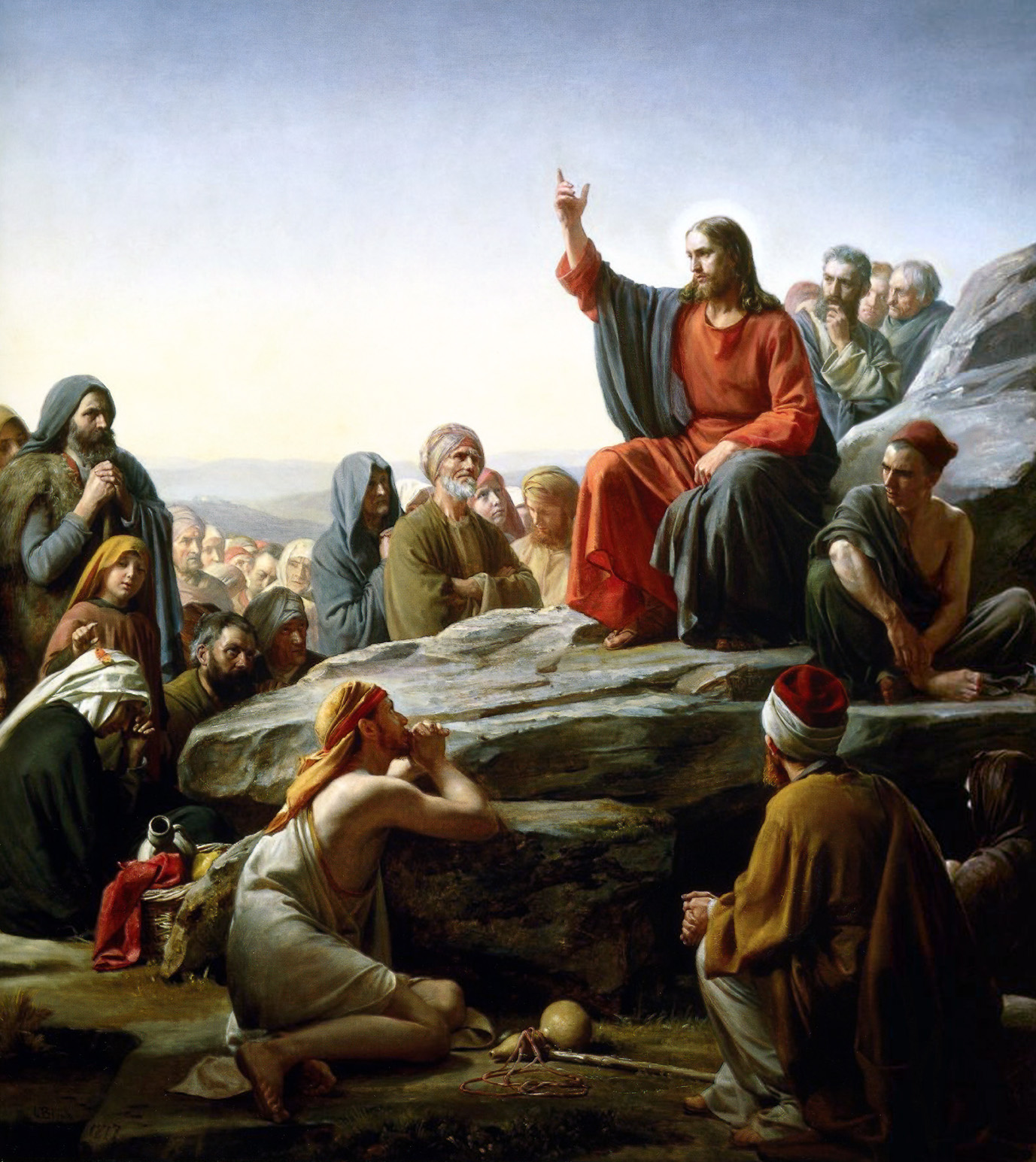
[1] Carl Heinrich Bloch [Public domain], via Wikimedia Commons
[2] Adapted from article by Adam Myrick in the Southwestern News (Fall 2000)
[3] Rev. Boyd Holliday
[4] Jeremiah 12:1b
[5] Genesis 1, the Creation account
[6] Adapted from article by Adam Myrick in the Southwestern News (Fall 2000)