Showing posts with label Kingdom. Show all posts

Wednesday, March 23, 2016

Holy Week on Wednesday

                                                                                                  Wednesday, March 23, 2016

Go to VIDEO


Now Jesus was deeply troubled, and he exclaimed, “I tell you the truth, one of you will betray me!”  The disciples looked at each other, wondering whom he could mean.  The disciple Jesus loved was sitting next to Jesus at the table.   Simon Peter motioned to him to ask, “Who’s he talking about?”  So that disciple leaned over to Jesus and asked, “Lord, who is it?”  Jesus responded, “It is the one to whom I give the bread I dip in the bowl.”  And when he had dipped it, he gave it to Judas, son of Simon Iscariot.  When Judas had eaten the bread, Satan entered into him.  Then Jesus told him, “Hurry and do what you’re going to do.”  None of the others at the table knew what Jesus meant.  Since Judas was their treasurer, some thought Jesus was telling him to go and pay for the food or to give some money to the poor.  So Judas left at once, going out into the night.    John 13:21-30(NLT) 

Going out into the night; what an ominous phrase that is, considering what we know about Judas on this side of history.  He went dark that night, but it certainly didn’t begin that night!  As the treasurer, Judas had given into the lure of money well before accepting 30 pieces of silver to betray the Son of God with a kiss.

When Jesus declared that one would betray him, it was Judas who asked, is it I?[2]  The fact that Judas surrendered to Satan’s will at the supper brings more ominous thoughts. 

Paul tells us:

So anyone who eats this bread or drinks this cup of the Lord unworthily is guilty of sinning against the body and blood of the Lord.  That is why you should examine yourself before eating the bread and drinking the cup.  For if you eat the bread or drink the cup without honoring the body of Christ, you are eating and drinking God’s judgment upon yourself.  That is why many of you are weak and sick and some have even died. 
1 Corinthians 11:27-30(NLT)

Examine yourself!  Notice, however, Paul did not write:  Examine others!  This Supper is intensely personal. 

However praying for others is certainly appropriate as the Body of Christ prepares to share one loaf and one cup – the one body and blood of her Lord.  Judas had been stealing for some time from the disciples’ purse; I can’t help but sense that, while we cannot know everything about each of those with whom we worship, constant prayer offered for our brothers and sisters would save many a potential Judas.

One of my prayers at the table is:  Lord, is it I…have I slipped into betrayal?  Search me, Lord; bring to my mind even the smallest detail; help me clear my heart before You.

When one serves communion it is impossible to miss the myriad of diverse faces before you, as you look people in the eye and declare:   the body of Christ, given for you. 

Mostly there is that smile, eyes then lowered and a sighed, thanks be to God.  Often there is a nod of acceptance, or a simple, humble look of gratitude. 

Sometimes there is a worried or confused look – and at such times my prayer is immediate for the one before me:

Father, grant her victory in whatever burden she faces; grant him peace.

While the Bible’s many stories of victory and overcoming faith are there to help us, inspire us, and lead us to stronger faith, the Judas stories are there to warn us, and help keep us from repeating unbelief and rebellion, or worse, indifference towards God.

While we do not celebrate the Lord’s Supper every day, we do eat several times a day.  Taking a moment before a meal to offer thanks can fall into a habitual ritual; but it doesn’t have to – not if you take the time as you prepare to eat to examine yourself for signs of going out into the night.  

For You Today


Holy Week – Holy Day today – Holy meal…every time.

You chew on that as you hit the Rocky Road today…and have a blessed day!


[1] Title Image:  By Andrew A. Shenouda from Riyadh, Saudi Arabia (It's the Holy Week!), via Wikimedia Commons
[2] Matthew 26:25

Tuesday, March 22, 2016

Holy Week on Tuesday

                                                                                                 Tuesday, March 22, 2016

Go to VIDEO


Some Greeks who had come to Jerusalem for the Passover celebration paid a visit to Philip, who was from Bethsaida in Galilee.  They said, “Sir, we want to meet Jesus.”  Philip told Andrew about it, and they went together to ask Jesus.   Jesus replied, “Now the time has come for the Son of Man to enter into his glory.  I tell you the truth, unless a kernel of wheat is planted in the soil and dies, it remains alone.  But its death will produce many new kernels—a plentiful harvest of new lives.  Those who love their life in this world will lose it.  Those who care nothing for their life in this world will keep it for eternity.  Anyone who wants to serve me must follow me, because my servants must be where I am.  And the Father will honor anyone who serves me.    John 12:20-26(NLT) 

It was a simple enough request; it’s hard to understand why Philip just didn’t take the Greeks to Jesus.

This passage has always seemed to me a microcosm of what is sometimes the biggest problem we have in the church – an “organizational-bog” nightmare.  The travelers who came to Jerusalem wanted to see Jesus, so they made their request to one of the organization’s insiders, Philip.  Philip turned it into a committee project, telling Andrew, and together they brought it to Jesus, chair of the board, for approval.

Jesus’ answer must have confused the disciples, because he didn’t give them an answer they could take back to the delegation who wanted to meet the carpenter from Galilee.  Instead, with a wistful look in his eyes, Jesus starts talking about seed-planting and harvests, loving and hating life, and servants his Father will honor.

How could the disciples make sense of responses like these in the face of an important request to which the board must give an answer?  Was the chairman losing it?

One day, more than thirty years ago, our youngest daughter, Carrie gave me an answer to that question.  Think wide-open baby blue eyes, blonde pigtails and a smile that melts even the coldest heart. She was only three, and overheard Elizabeth and I talking about the bills, and my whining about how there just wasn’t enough money this month.  Carrie went to her room and then showed up at the table where I’d been agonizing over the budget.  “Here, Daddy, you can use my money.”  She held up a pudgy little opened hand containing three pennies. 

The answer to my money woes was not to be found in the income and outgo of a budget and checkbook, but a different way of thinking about God’s supply and demand.  I had been thinking in terms of “covering the bills” while my child understood the greater principle of how love gives everything.

And that’s what Jesus was talking about to Andrew and Philip.  They were concerned about the schedule of appearances and whether Jesus would have time to meet another request on his time.  But Jesus wanted them to lift their eyes higher to a cross and the sacrifice of the ages.

Jesus knew you don’t build a kingdom with tweet-followers, elections or donations; it’s a matter of making yourself available for God’s altar.

For You Today


It’s a good principle to remember today (and always) when you get a somewhat confusing answer…God’s ways are a little higher than yours.  When it doesn’t seem to make sense, look up!

You chew on that as you hit the Rocky Road today…and have a blessed day!


[1] Title Image:  By Andrew A. Shenouda from Riyadh, Saudi Arabia (It's the Holy Week!), via Wikimedia Commons

Wednesday, January 27, 2016

What's in YOUR Kingdom?

Wednesday, January 27, 2016

VIDEO


Previously on the Judah melodrama:  Jeremiah the prophet has been in prison for displeasing the king by speaking the truth about the Kingdom of Judah’s bleak future, if they don’t repent.  Their arch-enemy, Babylon, is gathering war troops like a storm on the horizon.  And the king, petulant as ever, hears a new message from Jeremiah, delivered by overnight Baruch scroll express; the king cuts it up, throwing each piece into the fire.

The drama continues:

After the king had burned the scroll on which Baruch had written Jeremiah’s words, the Lord gave Jeremiah another message.  He said, “Get another scroll, and write everything again just as you did on the scroll King Jehoiakim burned.  Then say to the king, ‘This is what the Lord says:  You burned the scroll because it said the king of Babylon would destroy this land and empty it of people and animals.  Now this is what the Lord says about King Jehoiakim of Judah:  He will have no heirs to sit on the throne of David.  His dead body will be thrown out to lie unburied—exposed to the heat of the day and the frost of the night.  I will punish him and his family and his attendants for their sins.  I will pour out on them and on all the people of Jerusalem and Judah all the disasters I promised, for they would not listen to my warnings.’”  So Jeremiah took another scroll and dictated again to his secretary, Baruch.  He wrote everything that had been on the scroll King Jehoiakim had burned in the fire.  Only this time he added much more!  Jeremiah 36:27-32(NLT)

The old saying about power being a corrupting influence on a person, and absolute power corrupting absolutely is an old saying for a very good reason; it’s true!  And truth has a habit of staying around long after the echo of lies has abated.

For our visual evidence this morning, look the picture entitled “Ruins” by the photographer; it is the ruins of a castle in lower Austria.  While the scene is quite impressive against the backdrop of a city in the valley below, if we wish to maintain appropriate perspective, remember that what remains on that mountaintop speaks of a momentary flash of grandeur by the former owner.  Those people are long dead; their “kingdom” is but a footnote against the backdrop of humanity, which, itself is only a small blip in eternity’s lifeline.

Jehoiakim was a king, but he didn’t understand this.  And any ruler who doesn’t get it will fare no better than the bleached bones exposed to the elements that marked the king of Judah’s final epitaph.

By comparison, when confronted with the Word of God, another earlier king named David, who had sinned just as badly as Jehoiakim, didn’t cut up the scroll and burn it; rather he let the Word of God burn out of his life all that separated him from God.

And that’s a good lesson for a ruler…or a citizen. 

Yesterday we looked at the lack of humility in the candidates running in our current election cycle.  Today, let’s reflect on what kind of people elect such arrogant, God-despising leaders.

What kind of scroll would Baruch overnight to us?

And, when confronted with our own sins, will we remember Jehoiakim and not burn the message (or the messenger)?  Could it be that it’s time to repent and let the fire-power of God’s cleansing Word transform our allegiance to a lasting kingdom?

For You Today


What’s in YOUR kingdom?  And is it an eternal one, or is it bound for ruins?

You chew on that out on that Rocky Road today…and have a joy-filled and blessed day!


[1] Title image:  By Uoaei1 (Own work), via Wikimedia Commons

Tuesday, March 3, 2015

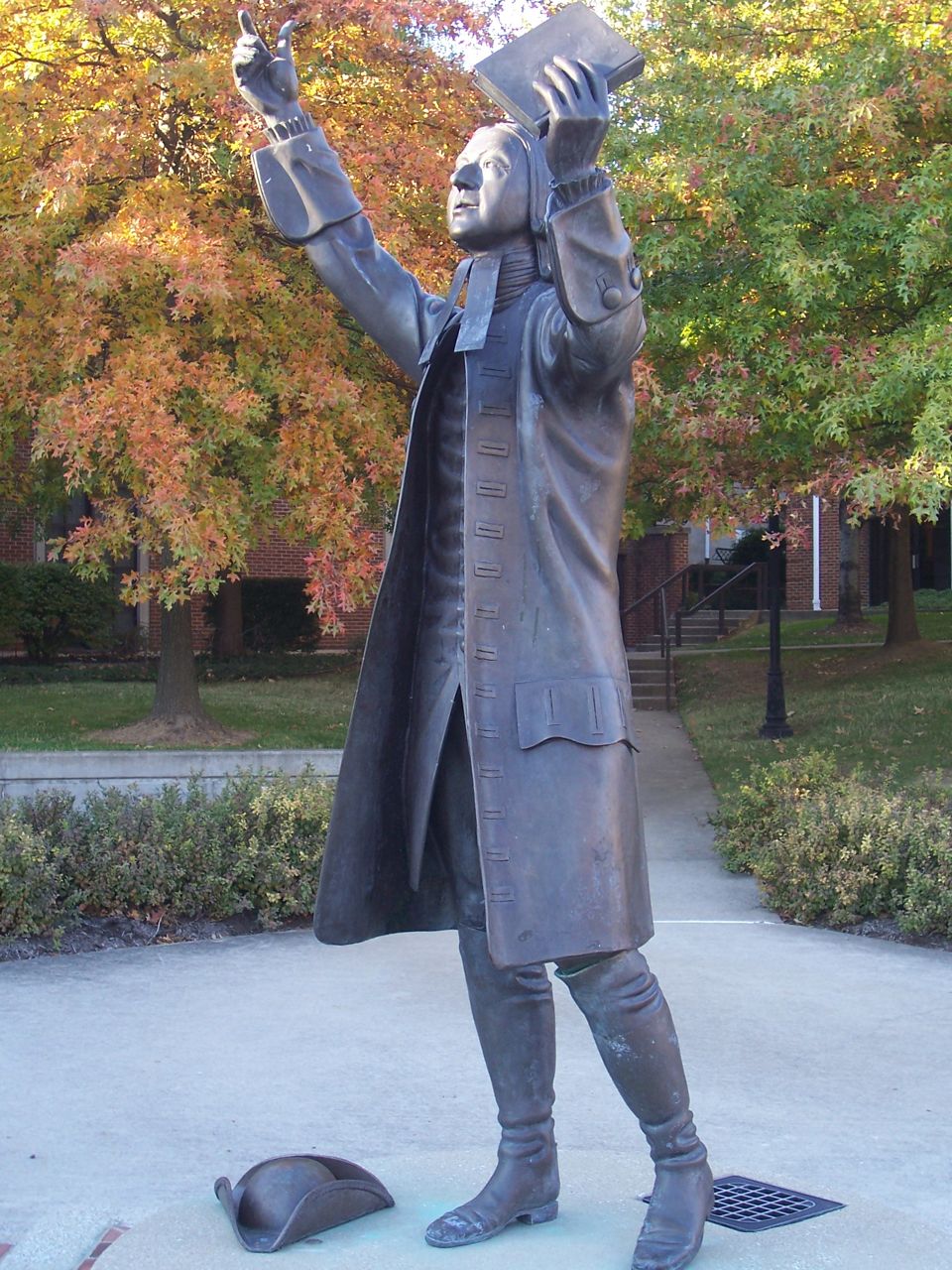
John Wesley; Plain Preacher

[1]   
Wednesday, March 4, 2015
And my message and my preaching were very plain.  Rather than using clever and persuasive speeches, I relied only on the power of the Holy Spirit.
1 Corinthians 2:4 (NLT)
John Wesley, the 18th century founder of Methodism, had a penchant for “plain preaching”.  Though his written sermons were theologically brilliant, logically-organized and academically-powerful, his so-called field preaching was so “user-friendly” to field hands, factory workers and the poorest, uneducated common person.  But that was not natural for Wesley; he had to work at learning to put aside the big words!

James Kiefer has a story that survives about Wesley which helps us understand why Wesley’s personal charm and commitment to reaching the least of these turned into a powerful movement for Christ:

The early Methodist meetings were often led by lay preachers with very limited education.  On one occasion, such a preacher took as his text Luke 19:21, "Lord, I feared thee, because thou art an austere man."  Not knowing the word "austere," he thought that the text spoke of "an oyster man."  He spoke about the work of those who retrieve oysters from the sea-bed.  The diver plunges down from the surface, cut off from his natural environment, into bone-chilling water.  He gropes in the dark, cutting his hands on the sharp edges of the shells.  Now he has the oyster, and kicks back up to the surface, up to the warmth and light and air, clutching in his torn and bleeding hands the object of his search.  So Christ descended from the glory of heaven into the squalor of earth, into sinful human society, in order to retrieve humans and bring them back up with Him to the glory of heaven, His torn and bleeding hands a sign of the value He has placed on the object of His quest.  Twelve men were converted that evening.  Afterwards, someone complained to Wesley about the inappropriateness of allowing preachers who were too ignorant to know the meaning of the texts they were preaching on.  Wesley, simply said, "Never mind, the Lord got a dozen oysters tonight."[2] 

John Wesley obviously understood the nature of priority – putting aside the trivial in favor of getting the job done.  That’s usually a matter of pride losing when it would rather win.

In a day when many Methodist established churches go literally years without seeing a single soul come to Christ, the story of an uneducated, but Christ-honoring layman leading a service in which 12 people come to their knees in conversion should either stir us or shame us into getting back to why we are sent in the first place; we are sent to proclaim the saving message of the cross wherever and to whomever we encounter, with the express intention of winning them to the Kingdom.

For You Today

A good question to ask while facing the mirror today is: 
What am I doing about this first kingdom-priority of winning souls for Christ?  

And a second question then becomes unavoidable:
Am I comfortable stopping there…or will I press on with plain preaching to win more “oysters”?


[1] Title Image: By Adam Davenport, via Wikimedia Commons
[2] James Kiefer on Mission St Clare