Showing posts with label Naaman. Show all posts

Monday, August 21, 2023

Faith Birthing More Faith

Monday, August 21, 2023

The king of Aram had great admiration for Naaman, the commander of his army, because through him the Lord had given Aram great victories. But though Naaman was a mighty warrior, he suffered from leprosy.  At this time Aramean raiders had invaded the land of Israel, and among their captives was a young girl who had been given to Naaman’s wife as a maid.  One day the girl said to her mistress, “I wish my master would go to see the prophet in Samaria.  He would heal him of his leprosy.”  

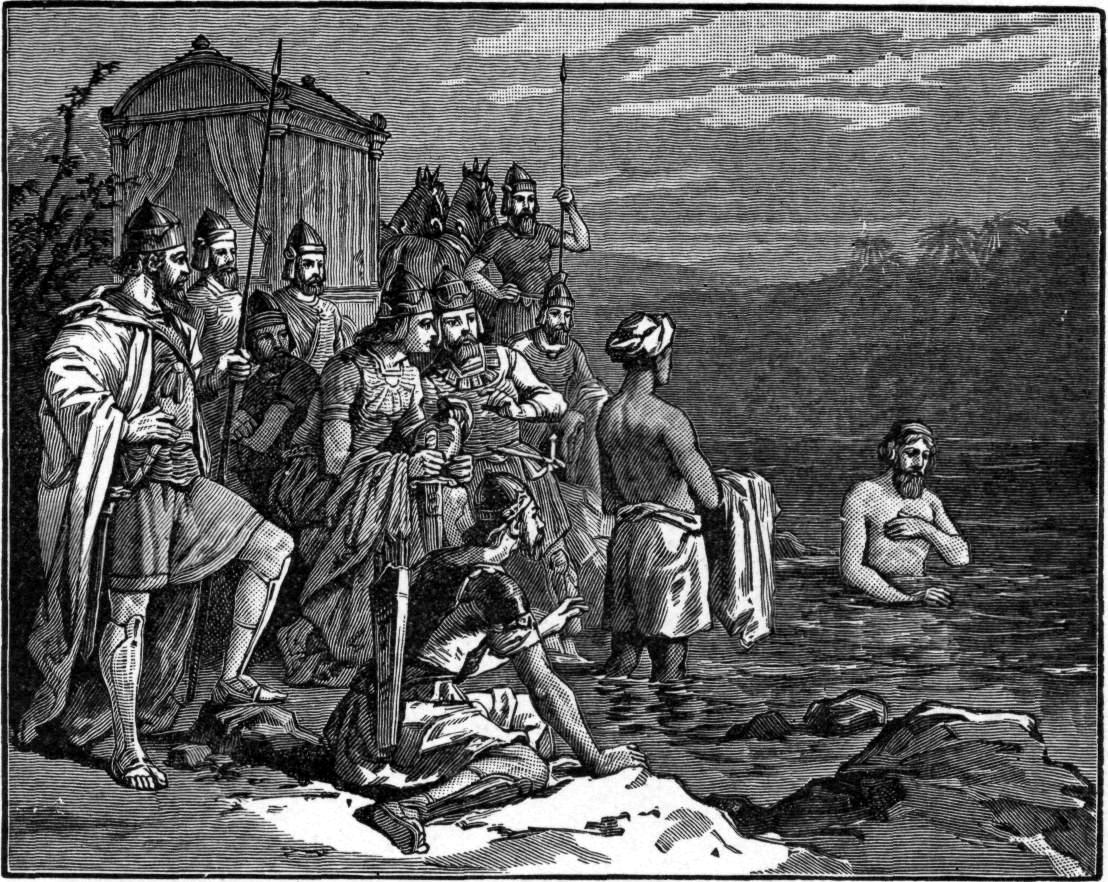
So Naaman went with his horses and chariots and waited at the door of Elisha’s house.  But Elisha sent a messenger out to him with this message: “Go and wash yourself seven times in the Jordan River.  Then your skin will be restored, and you will be healed of your leprosy.”  But Naaman became angry and stalked away. “I thought he would certainly come out to meet me!” he said. “I expected him to wave his hand over the leprosy and call on the name of the Lord his God and heal me!  Aren’t the rivers of Damascus, the Abana and the Pharpar, better than any of the rivers of Israel?  Why shouldn’t I wash in them and be healed?” So Naaman turned and went away in a rage.  But his officers tried to reason with him and said, “Sir, if the prophet had told you to do something very difficult, wouldn’t you have done it?  So you should certainly obey him when he says simply, ‘Go and wash and be cured!’”  So Naaman went down to the Jordan River and dipped himself seven times, as the man of God had instructed him.  And his skin became as healthy as the skin of a young child, and he was healed!  2 Kings 5:1-3, 9-14

This is one of those favorites in Scripture, because it has one of the most dramatic illustrations (on so many levels) of the purity and exceptional nature of faith. 

First, the servant girl, who expresses love for the master who owns her.  In compassion she wishes aloud her master would go to Elisha to be healed.  Naaman acts in faith that is clouded with expectations of a grand show of magical powers, but the prophet won’t even answer the door; he sends a servant to tell the sick man to exercise a more profound faith…go dip in the Jordan seven times! 

When Naaman’s expectations are ignored, he gets angry and, in his rage, wants to take his ball and go home.  But his servants convince him with logic…you wanted a grand show, and you got a simple request:  If it was some hard thing, you’d have done it…what’s a little dip in the muddy waters?  Naaman caves, and the healing evidence becomes history!

I love this account of Naaman’s healing because it is our story of faith in Christ.  Sin in the soul is immeasurably more damning than leprosy in the flesh.  Leprosy can kill only a temporary skin-and-bone body; sin in our immortal soul condemns our eternal being to a never-ending separation from God. 

We are all Naaman…confronted with our sinful ways, we’re faced with the decision to have faith in God by trusting in Christ’s sacrifice on the cross for our sins, or remain rotting in our chosen sinful ways. 

For You Today 

You have a choice to make, much like Naaman.  Apostle Matthew records the exact words of Jesus about this eternally-significant choice:

Don’t be afraid of those who want to kill your body; they cannot touch your soul.  Fear only God, who can destroy both soul and body in hell.  

Matthew 10:28

Hardly any advice needed on this, simply an invitation:  trust Christ now, and be forever thankful for His gift of eternal life.

You chew on that as you hit the Rocky Road; have a blessed day!

Go to VIDEO

There are about 2,600 devotional posts and 400 sermons in the Rocky Road library. 

Title Image:  via WikimediaCommons   Images without citation are in public domain.  

Unless noted, Scripture quoted from NLT©   

Tuesday, August 27, 2019

James the Just - Part 12 - Praying for People

Wednesday, August 28, 2019

Elijah was as human as we are, and yet when he prayed earnestly that no rain would fall, none fell for three and a half years! Then, when he prayed again, the sky sent down rain and the earth began to yield its crops.  My dear brothers and sisters, if someone among you wanders away from the truth and is brought back, you can be sure that whoever brings the sinner back from wandering will save that person from death and bring about the forgiveness of many sins.  James 5:17-20

Intercession and reconciliation – that’s the ministry of the body of Christ.  Abraham was the beginning of the nation of Israel, God’s chosen people.  They were to intercede, bring God’s message to the world.  The church is the “new Israel,” and our calling is the same; we are to present the gospel of Jesus Christ to a lost world.  That’s not easy!  Intercession is standing in the gap – for the lost, the sick, the needy.  When you stand in a gap between God and the people God has told you to help, you’re doing what William Carey[2] the father of modern missions said:
Attempt great things for God; 
expect great things from God
It is like a small child turning over his security blankey to Dad, trusting that Dad won’t hurt him. 
That Charlotte, NC farmer in 1934 had spent a good deal of time battling a stubborn farm during the Great Depression.  Raising a family was tough work then…as it is now – only in a different way.  Still tough!  The Depression had spread spiritual apathy in the city.  But, when asked, the farmer lent out one of his pasture fields to some business leaders for a day of prayer.  A man named Vernon Patterson lead the prayer this way:  O Lord, raise up from Charlotte someone to preach the gospel to the ends of the earth.   Those businessmen erected a tabernacle of pine beams in the city.  For the next eleven weeks an evangelist by the name of Mordecai Ham shattered the complacency of church-going Charlotte.  
The farmer who lent his pasture for the original prayer meeting was named Franklin Graham.  During the revival, Franklin’s young son, Billy, responded to Christ, and committed his life.  These days we call him Dr. Graham.  Only eternity will reveal how many souls were touched for Christ beginning with one farmer willing to let go of a field for a while, and one businessman willing to trust God for the sake of the gospel.
How can I trust God like that?
Do you remember what happened when Mrs. Job looked her man in the eyes and said, You’ve lost it all, children, possessions, reputation and even your health – why don’t you just curse God and die?  He said, Though he slay me I’ll worship him.  That was Job, choosing to trust God.
Do you remember Naaman the Leper?  God’s prophet said, Go dip in the Jordan river seven times to be healed.  Naaman grumbled, but he went.  Each time he bobbed up in the water, it was Naaman choosing to trust God:  Here, God of Elisha, take my choices; I trust You!
The big fisherman, Peter, knew something about faith that had fizzled.  Outside Pilate’s house the night Jesus was arrested Peter was confronted by a little girl who thought he was one of Jesus’ disciples.  Peter cursed:  I don’t know Jesus!  It was Peter’s unbelief, no trust at all.  After the crucifixion, he back went home to do some fishing.  What happened?  He had a meeting with Jesus, the resurrected Lord of the universe.  And Peter found out he was forgiven.  All that cowardice and backpedaling…forgiven.  Peter chose to trust, and God taught him for the rest of his life HOW to trust.
For You Today
Preacher, I want to trust God that way; how do I do that? 
Answer:  You just do it; you choose to do it. 
You chew on that as you hit the Rocky Road; have a blessed day.

Go to VIDEO


[1] Title Image:  Courtesy of  Wikimedia Commons     Unless otherwise noted, Scripture used from The New Living Translation©
[2] 1761-1834

Monday, July 8, 2019

Legacy of Leprosy

Tuesday, July 9, 2019

“Go in peace,” Elisha said. So Naaman started home again.  But Gehazi, the servant of Elisha, the man of God, said to himself, “My master should not have let this Aramean get away without accepting any of his gifts.  As surely as the Lord lives, I will chase after him and get something from him.”  So Gehazi set off after Naaman.  When Naaman saw Gehazi running after him, he climbed down from his chariot and went to meet him.  “Is everything all right?” Naaman asked.  “Yes,” Gehazi said, “but my master has sent me to tell you that two young prophets from the hill country of Ephraim have just arrived.  He would like 75 pounds of silver and two sets of clothing to give to them.”  “By all means, take twice as much silver,” Naaman insisted.  He gave him two sets of clothing, tied up the money in two bags, and sent two of his servants to carry the gifts for Gehazi.  But when they arrived at the citadel, Gehazi took the gifts from the servants and sent the men back.  Then he went and hid the gifts inside the house.  When he went in to his master, Elisha asked him, “Where have you been, Gehazi?”  “I haven’t been anywhere,” he replied.  But Elisha asked him, “Don’t you realize that I was there in spirit when Naaman stepped down from his chariot to meet you?  Is this the time to receive money and clothing, olive groves and vineyards, sheep and cattle, and male and female servants?  Because you have done this, you and your descendants will suffer from Naaman’s leprosy forever.”  When Gehazi left the room, he was covered with leprosy; his skin was white as snow.  2 Kings 5:19-27

Naaman, commander of the most powerful army in the world awoke one day to discover he had leprosy.  He would’ve traded all his power and wealth for a good doctor’s report.  When he went to the prophet he got just that…jaundiced, sickly skin, covered in sores and scabs, bordering on rotting, was now smooth and clear.
Naaman was overjoyed and wanted to shower the prophet with gifts of gold, silver, and a lavish wardrobe.  Elisha refused, but Gehazi, his servant couldn’t resist.  He went behind the prophet’s back, running after Naaman, lying straight-faced to him, and managing to snag 150 pounds of silver for himself (worth about $36,000 in today’s money[2]).  Gehazi hid the money, but the prophet knew all about it and the tables turned very quickly. 
The upshot of the story is incredible.  Naaman, a heathen, hardened military political power broker who had every advantage except health was willing to trade it all for relief from leprosy.  He got the relief and became a worshipper of the Lord God.  Gehazi, servant of Elisha, who had seen the prophet’s connection with God as Elisha performed miracles, and who had witnessed the might of JHWH defeating the foes of Israel without so much as a skirmish, traded away his own health, and that of his children and grandchildren, not to mention the possibility of passing along a good name, for some stolen bags of silver, just enough to make a good down payment on a funeral.
The contrast of the two men is striking.  Naaman was sickly and willing to give it all away for the blessing of God.  Gehazi lived in the blessing of God and wanted what Naaman had.  He got way more than he bargained for.
For You Today
Scripture says that contentment with godliness is itself great wealth.[3]  Like Gehazi we always have a choice, we can be content and let our thoughts and lives dwell with God and His ways, or we can trade away our contentment for a little silver or gold…and leave a leprous legacy; should be a no-brainer for believers!
You chew on that as you hit the Rocky Road; have a blessed day.

Go to VIDEO


[1] Title Image:  Pixabay.com        Unless otherwise noted, Scripture used from The New Living Translation©
[2] According to Silver Market price
[3] 1 Timothy 6:6

Tuesday, February 5, 2019

Reasonable Faith

Tuesday, February 5, 2019

The king of Aram had great admiration for Naaman, the commander of his army, because through him the Lord had given Aram great victories.  But though Naaman was a mighty warrior, he suffered from leprosy.  At this time Aramean raiders had invaded the land of Israel, and among their captives was a young girl who had been given to Naaman’s wife as a maid.  One day the girl said to her mistress, “I wish my master would go to see the prophet in Samaria.  He would heal him of his leprosy.”  So Naaman told the king what the young girl from Israel had said.  “Go and visit the prophet,” the king of Aram told him.  “I will send a letter of introduction for you to take to the king of Israel.”  So Naaman started out, carrying as gifts 750 pounds of silver, 150 pounds of gold, and ten sets of clothing.  The letter to the king of Israel said:  “With this letter I present my servant Naaman.  I want you to heal him of his leprosy.”  When the king of Israel read the letter, he tore his clothes in dismay and said, “Am I God, that I can give life and take it away?  Why is this man asking me to heal someone with leprosy?  I can see that he’s just trying to pick a fight with me.”  But when Elisha, the man of God, heard that the king of Israel had torn his clothes in dismay, he sent this message to him:  “Why are you so upset?  Send Naaman to me, and he will learn that there is a true prophet here in Israel.”  So Naaman went with his horses and chariots and waited at the door of Elisha’s house.  But Elisha sent a messenger out to him with this message:  “Go and wash yourself seven times in the Jordan River.  Then your skin will be restored, and you will be healed of your leprosy.”  But Naaman became angry and stalked away.  “I thought he would certainly come out to meet me!” he said.  “I expected him to wave his hand over the leprosy and call on the name of the Lord his God and heal me!  Aren’t the rivers of Damascus, the Abana and the Pharpar, better than any of the rivers of Israel?  Why shouldn’t I wash in them and be healed?”  So Naaman turned and went away in a rage.  But his officers tried to reason with him and said, “Sir, if the prophet had told you to do something very difficult, wouldn’t you have done it? So you should certainly obey him when he says simply, ‘Go and wash and be cured!’”  So Naaman went down to the Jordan River and dipped himself seven times, as the man of God had instructed him.  And his skin became as healthy as the skin of a young child, and he was healed!  2 Kings 5:1-14(NLT)

Naaman was a powerful warrior who had leprosy, an ancient aids-like diagnosis; no matter your military prowess, this was a sentence of death.  Frantically willing to grasp at any straw of promise, Naaman carried a huge gift to the King of Israel to persuade him to pressure the prophet into healing his leprosy.  One estimate of the silver, gold and designer clothes approaches $1 million.[ii]  Healthcare has never been cheap, but that’s another story.
Naaman got healed despite himself.  If you survey the Scriptures, you’ll find that God always humbles the proud and exalts the humble.  If paying a million bucks to fend off the grim reaper wasn’t a sure thing, there was also the veiled threat that if Naaman didn’t get his request, the King of Aram, who had already defeated Israel in battle, would not be happy.  Naaman missed it entirely that you cannot buy God with gold, nor intimidate Him with your power.  I can imagine a little laugh echoing in heaven’s halls as God watches the mortal military genius flexing his leprosy-covered muscles.
Well the story displays a typical attitude of the privileged and powerful, supposing even the prophet of God would come bowing, scraping, and ready to cater to Naaman’s every wish.  It didn’t happen that way; Elisha sent his servant to the door and told the General to go take a bath in the muddy Jordan.  Dip seven times like a bobbing fish lure and see what happens.  This didn’t please Naaman at all, but his servants brought a little reason to the table, and convinced the dying, but proud man to do as the prophet had ordered.
In the end, Naaman learned a little humility can be a powerful friend; he also learned faith is not only the evidence of things not seen[iii], it is also the very substance of reason, which is doing things in God’s world the way God the Creator designed it. 
For You Today
Like Naaman, we all eventually come face to face with the truth that doing things God’s way is the only way…if you want to live! 
You chew on that as you hit the Rocky Road; have a blessed day.

Go to VIDEO


[i] Title Image:  via Wikimedia Commons
[ii] Jack Wald, Rabat International Church, in a sermon
[iii] Hebrews 11:1

Sunday, September 9, 2018

The Practicing Christian Series - #13 Eating the Elephant

þ The Internet (information highway) changed business and communication – the way we receive information – for good.
þ Political upheaval – We have seen the fall of communism.  We’ve seen Bush-to-Clinton-to-Bush-to Obama-to Trump; Wow!  Just, WOW!
þ The AIDS and Ebola viruses – stem cell research, and other assorted medical/ethical dilemmas make one wonder if the term medical advance is somewhat over-rated.
þ The ECONOMY is on a roller coaster ride.
þ There’s nothing left to eat that’s safe, except liver and okra! 
(OK…okra’s never been safe on my list!)

Are we doomed?  Is there an answer?

þ Some would say, “No – just hang tough, get what you can, get a tattoo, and be yourself; you’ll get by.”
þ Some would say, “Of course there’s an answer; just send me $500 – I’ll send you a prayer cloth, and soon you’ll be rich.”
þ Some would say, Here, drink/snort/vape this and you won’t worry about all that!
What does God say about all that?  The conclusion to our study of the Book of James gives us real solutions for those questions.  James tells us that the answers to those, and many more (in fact, all) of life’s nagging questions is found in prayer; specifically, true prayer – without a net…

In every phrase James has practical instruction for us as individuals, and a church body…praying without a net.
Several years ago I stood at the Grand Canyon…and got a little dizzy.  It is quite awesome to stand, looking out over that incredible hole in the ground.
My mind wandered to the old story of the famous acrobat, who attracted a huge crowd to watch him walk a tightrope across Niagara Falls.  He nimbly and skillfully passed over the waters below, suspended by a thin line – and, without a safety net!
“Bravo” yelled the crowd.  The performer spoke to the onlookers, “How many believe I could do this carrying someone on my shoulders?”  All hands shot up; “We believe, we believe.”
“Who would like to be first?”  The crowd went home!
Shouting Bravo when you have no intention of climbing on the man’s back is what I call “praying with a net.”  It is saying, “OK, I’ll pray about this, but if I get uncomfortable in this process, I’m gonna bail…I’ll go with something I can see.”  That something you can see is the safety net.  It is trusting in yourself as the one who can handle the problems if God won’t.
That is not the kind of prayer God wants to hear.  He wants to hear prayers offered by people who have no safety net – just faith in God.  But, preacher, that’s kind of like saying we should eat an elephant…that’s a really big job.  How do you do that?   All together now, class…one bite at a time!
What does it look like when a church family is ready to pray without a net?  What “marks” can you notice in a prayer ministry that is netless?  See James’ advice:

WE ARE TO PRAY CONSTANTLY –

Are any of you suffering hardships?  You should pray.  Are any of you happy?   You should sing praises.  James 5:13 (NLT)

James includes both ends of the human spectrum – in hardship or in happiness.  That takes in just about all of it, bad times or good.  A dear friend, Donna Smith, once told me, “I never say Amen I always have so much to pray about.”  That’s probably good advice; after all, when you’ve got God on the line, you wouldn’t want to hang up the phone, would you?
Praying constantly involves intentionality.  There must be something of a decision to organize your life around the things of God.  There must be a readiness to respond to the leading of God.  If not, you’re operating with a net.
Without intentionally linking yourself to God, you’re at the mercy of the happenstance of life.  Actually, you have no net; it just seems like you have one. 
Take a Styrofoam cup, place it on the centerline of a highway; the first car that passes will cause it to jump in that direction.  As another car passes on the opposite side, it will be snapped-back the other way.  If two cars pass at the same time it will not know which way to jump.  James knew this principle:

But when you ask him, be sure that your faith is in God alone.  Do not waver, for a person with divided loyalty is as unsettled as a wave of the sea that is blown and tossed by the wind.  Such people should not expect to receive anything from the Lord. Their loyalty is divided between God and the world, and they are unstable in everything they do.  James 1:6-8(NLT)

Intentional praying is when you link yourself to God constantly, allowing Him to determine the outcome of things.  It means you relinquish control. It is like taking that Styrofoam cup off the centerline on the road and placing it in God’s truck.  You’ve made a decision about your direction – you’re going with God. 
That’s hard, isn’t it? Doing things God’s way is hard, isn’t it?   But, in the long run, that is the easiest way, because (as Jesus said) it’s God’s way, and His yoke is easy, His burden light.[2] 
Constant prayer – without a net – is no burden…it is the joy of being close to the Lord.  He is the source of beauty, love, health and joy.  What’s burdensome about being near THAT all the time?

WE ARE TO PRAY FOR HEALING

Are any of you sick?  You should call for the elders of the church to come and pray over you, anointing you with oil in the name of the Lord.  Such a prayer offered in faith will heal the sick, and the Lord will make you well.  And if you have committed any sins, you will be forgiven.  James 5:13-20(NLT)

Pray for the sick – well, we’ve got that one down.  I recently saw a cartoon where an elderly woman is standing at the church door talking to the pastor.  Her remark, as she hands a thick manila folder to him:  My doctor copied my chart, complete with medicines and prognosis…just copy it into the prayer list, please.
We pray for the sick constantly here – and God has at times responded with healings!  But, while we’re praying that our loved ones get better physically, we should not forget the other needs, emotional healing, spiritual healing, and relationships.
There is more spiritual virus affecting this world than any heart or liver diseases, or strains of AIDS or Ebola.  If we are going to pray without a net in today’s spiritual warfare of morals, worldview and culture, we will have to take a stand. 
It’s never hard to get people to agree to pray for someone battling against cancer, or a heart attack.  But these are minor, incredibly minor, compared to the spiritual diseases of abortion, sexual perversion, cruelty and oppression.  The apostle Paul showed us the bullseye.  He said:

For we are not fighting against flesh-and-blood enemies, but against evil rulers and authorities of the unseen world, against mighty powers in this dark world, and against evil spirits in the heavenly places.  Ephesians 6.12(NLT)

The reason Paul said to put on the whole armor of God is because you need it when you pray for healing against the real sicknesses that can hurt people – the kind that can kill the spirit, and consign the soul to hell.

WE ARE TO PRAY WITH REPENTANCE

Confess your sins to each other and pray for each other so that you may be healed.  The earnest prayer of a righteous person has great power and produces wonderful results.  James 5:16(NLT)

Repenting means, in a literal sense, turning around.  It means a complete change of attitude towards sin…and a complete change of actions.  Heart and lifestyle change! 
Do you know how quickly the net is removed when we confess our sins to each other, seeking each other’s forgiveness?  That’s when we get help – real help – when we drop the fences, the walls.  To repent is to ask God to clean our slate – and then offer that clean slate back to Him, so He can begin to write our new future.
The earnest prayer of a righteous person could be restated…The one who has a clean slate and goes to work praying…  If you want to be part of a net-less prayer ministry, cleaning the slate is a daily reality.  God uses cleaned vessels.

WE ARE TO INTERCEDE AS WE PRAY

Elijah was as human as we are, and yet when he prayed earnestly that no rain would fall, none fell for three and a half years! Then, when he prayed again, the sky sent down rain and the earth began to yield its crops.  My dear brothers and sisters, if someone among you wanders away from the truth and is brought back, you can be sure that whoever brings the sinner back from wandering will save that person from death and bring about the forgiveness of many sins.  James 5:17-20(NLT)

Intercession and reconciliation – that’s the ministry of the body of Christ.  Abraham was the beginning of the nation of Israel, God’s chosen people.  They were to intercede, bring God’s message to the world. 
The church is the “new Israel,” and our calling is the same; we are to present the gospel of Jesus Christ to a lost world.  That’s not easy!
Intercession is standing in the gap – for the lost, the sick, the needy.  When you stand in a gap between God and the people God has told you to help….there is no net!
Intercessory prayer hands the net to God.  It is when you do what William Carey[3] the father of modern missions said:
Attempt great things for God; 
expect great things from God
It is like a small child turning over his security blankey to Dad, trusting that Dad won’t hurt him.
That Charlotte, NC farmer in 1934 had spent a good deal of time battling a stubborn farm during the Great Depression.  Raising a family was tough work then…as it is now – only in a different way.  Still tough! 
The Depression had spread spiritual apathy in the city.  But, when asked, the farmer lent out one of his pasture fields to some business leaders for a day of prayer.  A man named Vernon Patterson lead the prayer:  O Lord, raise up from Charlotte someone to preach the gospel to the ends of the earth.”
Those businessmen erected a “tabernacle” of pine beams in the city.  For the next eleven weeks an evangelist by the name of Mordecai Ham shattered the complacency of church-going Charlotte.
The farmer who lent his pasture for the original prayer meeting was named Franklin Graham.  During the revival, Franklin’s young son, Billy, responded to Christ, and committed his life. 

These days we call him Dr. Graham.  Only eternity will reveal how many souls were touched for Christ beginning with one farmer willing to let go of a field for a while, and one businessman willing to pray without a net for the sake of the gospel.  

How can I get rid of the net?

Preacher, I want to trust God that way.  I really want to pray without a net.  How do I do that?  Answer:  You just do it.  Really!
Do you remember what happened when Mrs. Job looked her man in the eyes and said, “You’ve lost it all, children, possessions, reputation and even your health – why don’t you just curse God and die?”  He said, “Though he slay me I’ll worship him.”  That was Job, handing God the net.
Do you remember Naaman the Leper?  God’s prophet said, “Go dip in the Jordan river seven times to be healed.”  Naaman grumbled, but he went.  Each time he bobbed up in the water, it was Naaman saying, “Here, God of Elisha, take my net.”
Do you remember how an angel told an unmarried 13-year-old girl she was going to have a baby?  And Mary, the virgin mother of our Lord, said, “I have no net.  Let God rule in my life.”
The big fisherman, Peter, knew something about nets.  Outside Pilate’s house the night Jesus was tried, then crucified, he protected his identity – “I don’t know Jesus” – a net!  After the crucifixion, he went home to do some fishing – back to the nets.  What happened?  He had a meeting with Jesus, the resurrected Lord of the universe.  And Peter found out he was forgiven.  All that cowardice and backpedaling…forgiven.  Peter just gave up his nets.
Later we find Peter and the apostles had a great healing ministry, but it disturbed the status quo amongst the religious leaders.  They had the apostles thrown in prison, but an angel freed them.  The religious leaders tried to shut them up from preaching Jesus – Peter and the others said, “We ought to obey God rather than men.”[4] 
That was Peter burning his nets behind him!
Most pictures I’ve ever seen of Jesus have his hands extended, palms up.  I’ve been told it is to show us his nail prints.  I’ve been told it means, “Come unto me…”
Today, for us, it should mean, Give me your nets…

In the name of the Father, Son, and Holy Spirit; Let the church say “Amen”!


[1] Title Image courtesy of Pixabay.com
[2] Matthew 11.30
[3] 1761-1834
[4] Acts 5.29