Showing posts with label Generosity. Show all posts

Wednesday, September 7, 2022

How Much is Enough?


Wednesday, September 7, 2022

Once a religious leader asked Jesus this question: “Good Teacher, what should I do to inherit eternal life?”  “Why do you call me good?” Jesus asked him.  “Only God is truly good.  But to answer your question, you know the commandments:  ‘You must not commit adultery.  You must not murder.  You must not steal.  You must not testify falsely.  Honor your father and mother.’”  The man replied, “I’ve obeyed all these commandments since I was young.”  When Jesus heard his answer, he said, “There is still one thing you haven’t done.  Sell all your possessions and give the money to the poor, and you will have treasure in heaven.  Then come, follow me.”  But when the man heard this he became very sad, for he was very rich.  When Jesus saw this, he said, “How hard it is for the rich to enter the Kingdom of God!  In fact, it is easier for a camel to go through the eye of a needle than for a rich person to enter the Kingdom of God!”  Those who heard this said, “Then who in the world can be saved?”  He replied, “What is impossible for people is possible with God.”  Peter said, “We’ve left our homes to follow you.”  “Yes,” Jesus replied, “and I assure you that everyone who has given up house or wife or brothers or parents or children, for the sake of the Kingdom of God, will be repaid many times over in this life, and will have eternal life in the world to come.”                 Luke 18:18-30

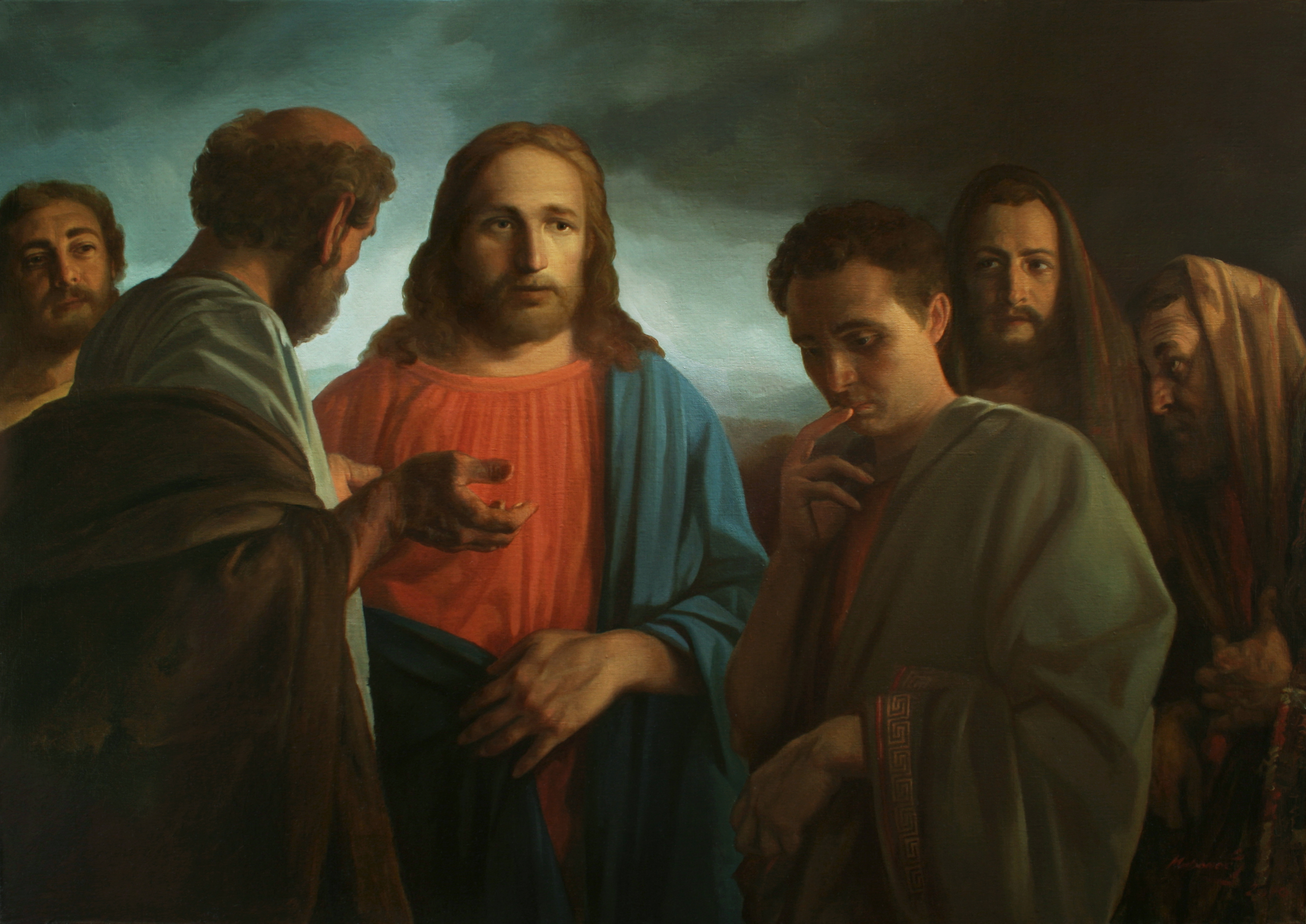
The painting of Christ with the rich young ruler reveals the angst-filled pathos of not having a clue when it comes to the destiny of our souls.  The young man asked the elephant-in-the-room question everyone else was thinking…uhhh, Jesus, what’s gonna happen to me in the long run…and what should I do about it?

The men surrounding Jesus are listening intently.  You can see skepticism, fascination, and true holding-your-breath-for-the-answer-honesty in their faces.  After all, you don’t throw-off the question of eternity like you’d discard a candy wrapper.  This was important…even a rich man, with the world at his disposal, couldn’t resist asking for insight on eternal life.

Jesus pointed the young man to what’s written in Scripture about obeying God’s commands, honesty, kindness, generosity, and so on.  But the young man pressed deeper, and Jesus obliged him, and went right for the underbelly of the issue; his answer was, quite pointedly:  What’s the most important thing you wouldn’t want to give up?  The answer welling-up in the young man’s soul made him sad, very sad!  How can you let go of what possesses you?

Peter, (to the left of Jesus in the painting) is standing there with hands unfolded in a questioning motion.  The artist, I believe, is giving Peter’s voice that hopeful edge, as he’s reminding Jesus how he and the other disciples left all they had to follow…was that enough?  Jesus’ answer isn’t a get-out-of-jail-free card, a Christian believer’s ID you can present at the pearly gates.  It’s more of a reminder that the final judgment on each of us is in God’s hands.  It is the Father who looks into each person’s heart and judges, repaying reward or punishment with absolute righteousness.

For You Today

The question the rich young man asked is not a bad one if you ask it with empty hands and open heart.  But a better question might be:  Lord, I have decided nothing I have belongs to me…what should I do with it; how can I follow you today?

You chew on that as you hit the Rocky Road; have a blessed day!

Go to VIDEO (read by author)

There are about 2,000 devotional posts and 400 sermons in the Rocky Road Devotions library.  To dig deeper on today’s topic, explore some of these: 

Unconvinced and More Than Enough

[1] Images:   WikimediaCommons - ©2010 Andrey Mironov   Unless noted, Scripture quoted from The New Living Translation©   

Tuesday, November 9, 2021

Widows & Orphans


Tuesday, November 9, 2021

Never speak harshly to an older man, but appeal to him respectfully as you would to your own father.  Talk to younger men as you would to your own brothers.  Treat older women as you would your mother, and treat younger women with all purity as you would your own sisters.  Take care of any widow who has no one else to care for her.  But if she has children or grandchildren, their first responsibility is to show godliness at home and repay their parents by taking care of them.  This is something that pleases God.  Now a true widow, a woman who is truly alone in this world, has placed her hope in God.  She prays night and day, asking God for his help.  But the widow who lives only for pleasure is spiritually dead even while she lives.  Give these instructions to the church so that no one will be open to criticism.  But those who won’t care for their relatives, especially those in their own household, have denied the true faith.  Such people are worse than unbelievers.                            1 Timothy 5:1-8

You cannot understate the importance of this passage.  Paul, the elder statesman of the fledgling Christian church, is passing along advice to a young pastor, his protégé, Timothy.  Paul is not simply handing Timothy a twelve-pound book of rules, but gives him life principles of attitudes and actions that apply at any age to the formation of Christian lives: 

·       Speaking to others with respect and care

·       Respect for women

·       Helping the helpless

·       Caring for aging family members

These life principles are so important in everyday living because they develop character and an attitude that strengthen any family towards Godliness, which leads to stronger, more Godly communities, that which is pleasing to God.

In our current culture, homelessness, divorce, domestic violence, and the abuse of children are not isolated numbers on a chart of trends; more they are the sad tell-tale spots of the spiritual illness that has rotted the strength of attitude and resolve to be Godly people.  We have managed to promote personal happiness as a cultural right so vigorously, Godliness has been disappearing in the rearview mirror. 

To illustrate that this is so, one need only point to the disarray of relationship our culture exhibits to God’s chief blessing for strength in the home – His church.  Say what you like about the demise of the importance of church in the 21st century, I lay blame at the feet of selfish desire to have personal fulfillment, rather than Godly wholeness.  Godly worship has changed from the obvious to the optional. 

Certainly, the abuses of clergy, ebb-and-flow of cultural preferences in worship styles, and other sad distractions do factor-in when it comes to the dismantling of institutions – including the church.  However, the real loser is the family.  The church has become the new widow, a directionless, homeless bride, slipping through the cracks of this culture’s quest for a supposed better life

It is time for those who truly worship God to state this message clearly and without apology, both in word and deed:

Without the church, families will become just another option,                                             not God’s primary gift of strength for all human existence.

For You Today

In another post, last year[1] I wrote:  It has been said that evangelism is one beggar telling another where he has found bread.  For the helpless, homeless, and hopeless among us, they must never become them or those people; WE must be one widow, orphan, or stranger showing another where there is kindness.

You chew on that as you hit the Rocky Road; have a blessed day!  

[1] Title and Other Images:  Wikimedia Commons (public domain)  Unless noted, Scripture quoted from The New Living Translation©   

[1] See post from January 31, 2020, Widows, Orphans, & Strangers


Thursday, February 27, 2020

Do WHAT?


Thursday, February 27, 2020

Then the Lord spoke to Jonah a second time:  “Get up and go to the great city of Nineveh, and deliver the message I have given you.”  This time Jonah obeyed the Lord’s command and went to Nineveh, a city so large that it took three days to see it all.  On the day Jonah entered the city, he shouted to the crowds:  “Forty days from now Nineveh will be destroyed!”  The people of Nineveh believed God’s message, and from the greatest to the least, they declared a fast and put on burlap to show their sorrow.  When the king of Nineveh heard what Jonah was saying, he stepped down from his throne and took off his royal robes.  He dressed himself in burlap and sat on a heap of ashes.  Then the king and his nobles sent this decree throughout the city:    “No one, not even the animals from your herds and flocks, may eat or drink anything at all.  People and animals alike must wear garments of mourning, and everyone must pray earnestly to God.  They must turn from their evil ways and stop all their violence.  Who can tell?  Perhaps even yet God will change his mind and hold back his fierce anger from destroying us.”  When God saw what they had done and how they had put a stop to their evil ways, he changed his mind and did not carry out the destruction he had threatened.   Jonah 3:1-10[1]


Second chances come in many different areas of life.  Relationships, career, health, and even games.  Most of the time there is some forgiveness involved, or, at the least, a softening that gives us a chance to make it right this time.  Jonah had that.  He’d stumbled at the first call to go to Nineveh; this time he made it count.  The whole city repented and turned to God, including the king.

It’s a preoccupation of mine how many second chances people walk past.  Perhaps one of the more well-known second chances is the pan handler; it’s a bit uncomfortable, but if you avert eye contact you can usually get past that guy on the corner of the street with the sign that always includes anything helps – God bless.  What’s “second chance” about that encounter is not merely that guy, or one of his tribe, being on virtually every major intersection you pass, but that we become so adept at ignoring the second chance to love being involved in mercy. 

It is safe to say Jonah would welcome the opportunity to explain just how awful it is to enable that guy begging on the corner.  In a free country you’re supposed to work and provide for yourself.  While it’s probably true that there are some who bear those signs asking your help (and dollar bills) who just find it easier to beg than work, there are probably many more who have just come to the end of their rope, and the knot at the end of that rope is you; they’ve become too accustomed to holding on to that knot, or too afraid to let go.

Jonah got a second chance to deliver God’s message of judgment and mercy.  Nineveh was promised destruction if they didn’t let go of the knot at the end of their wicked rope.  What was so unusual was the way they believed the message of God and repented…from the throne room to the brothels and barns.  The message of judgment brought change and a mission of mercy.  All Jonah had to do was let go of his own knotty rope of hatred towards the Ninevites and do as God had directed.

For You Today


No, O people, the Lord has told you what is good, and this is what he requires of you: to do what is right, to love mercy, and to walk humbly with your God.  Micah 6:8

You chew on that as you hit the Rocky Road; have a blessed day!

Title Image:  Pixabay.com   Unless noted, Scripture quoted from The New Living Translation©

Go to VIDEO


Friday, January 31, 2020

Widows, Orphans, and Strangers

Friday, January 31, 2020

“True justice must be given to foreigners living among you and to orphans, and you must never accept a widow’s garment as security for her debt.  Always remember that you were slaves in Egypt and that the Lord your God redeemed you from your slavery.  That is why I have given you this command.  “When you are harvesting your crops and forget to bring in a bundle of grain from your field, don’t go back to get it.  Leave it for the foreigners, orphans, and widows. Then the Lord your God will bless you in all you do.  When you beat the olives from your olive trees, don’t go over the boughs twice.  Leave the remaining olives for the foreigners, orphans, and widows.  When you gather the grapes in your vineyard, don’t glean the vines after they are picked.  Leave the remaining grapes for the foreigners, orphans, and widows.  Remember that you were slaves in the land of Egypt.  That is why I am giving you this command.  Deuteronomy 24:17-22

If I were left in charge of gathering the harvest of grapes, olives, or gain, it’s a certainty that there wouldn’t be much left after the fields had been picked.  There’s something in my soul of a waste-not/want-not mantra that cannot be denied.  If there’s a crust of bread left in last week’s loaf, this week’s new loaf cannot be opened in our home…under penalty of the Russell stare of intimidation.  In our household you just do not waste anything.
There are a lot of moving parts to the issue of the displaced, misplaced, and wandering homeless among us.  I, personally, do not have political programs worked out to solve the dilemma of all who suffer the crushing blows that make life crumble.  That said, there is a principle contained in these very specific commands of Moses; that principle is kindness over greed. 
The principle becomes easier to understand (and apply) when we put faces on the words.  When one is greedy the face that is projected on those who are in need is that of greed; a person saturated with goods and self only sees the other who wants what he has.  A person who is kind understands the face of hunger, homelessness, and fading hope.  Thinking of the harvest, which was the basis of economics in Moses’ day, Deuteronomy instructs us to be generous with those who have no part, no place, and hardly a reason to smile.
The perfect example of this principle of those who have plenty being kind enough to share with those who have little to nothing at all is seen in the incarnation of Jesus Christ.  God, who has everything, not only died for us on the cross, but did so after joining us in our humanity. 
·      That humanity had no claim on anything of goodness; we had evil as our legacy. 
·      That humanity had no place to call home; we didn’t belong in heaven, and our earth had been cursed by our sin and selfishness. 
·      That humanity had no plea for how we got in that condition; we chose our sin and separation from God. 
Humanity…you…and I…and all…were without. 
·      We were lost and undone; we were without strength or hope. 
·      We were the widows of our dying selves. 
·      We were the orphans of self-inflicted ignorance. 
·      We were the strangers of even who we are…aliens in our own skins. 
And He joined us.
For You Today
You chew on that as you hit the Rocky Road; have a blessed day!

Go to VIDEO


[1] Title Image:   Pixabay.com    Unless noted, Scripture quoted from The New Living Translation©

Tuesday, September 24, 2019

Unlocking True Generosity

Wednesday, September 25, 2019

Then, with the crowds listening, he turned to his disciples and said, “Beware of these teachers of religious law!  For they like to parade around in flowing robes and love to receive respectful greetings as they walk in the marketplaces.  And how they love the seats of honor in the synagogues and the head table at banquets.  Yet they shamelessly cheat widows out of their property and then pretend to be pious by making long prayers in public.  Because of this, they will be severely punished.”  While Jesus was in the Temple, he watched the rich people dropping their gifts in the collection box.  Then a poor widow came by and dropped in two small coins.  “I tell you the truth,” Jesus said, “this poor widow has given more than all the rest of them.  For they have given a tiny part of their surplus, but she, poor as she is, has given everything she has.”  Luke 20:45 – 21:3

Every time we get near Jesus in teaching mode He utters something that turns our thinking upside down.  When he pointed at the widow’s gift and said she gave more than everybody that day, even though she had given the smallest amount, He was showing us the key to opening true generosity in our lives; it’s never how much you put in the offering plate, or the size of the check you put in the envelope to a charity, it’s how much you keep that determines the size of your gift.
It’s amazing how children get this, while adults seem to struggle with it.  Our youngest child is having a birthday today (one with a zero attached…prayer please…happy birthday, sweetheart 😊 ).  When Carrie was little, perhaps only about 4, she overheard her mother and me talking about the income and outgo problem; there was a little too much month left over at the end of the money.  She went to her room, then came back to join us at the table.  We looked at that sweet, innocent face as she held up her pudgy little hand and opened it to reveal four pennies.  It is impossible to forget those words, here, Daddy, you can use my money.  Like the widow who kept nothing back, our little one had emptied her savings to help.
The condemnation of the preachers at the beginning of the story is for pride and the misuse of money.  Well, it seems there’s nothing new after all!  These proud, greedy leaders would have scoffed at the widow’s donation, or perhaps used it to guilt others into giving more to fatten the treasury, but one thing they were never going to do is follow the widow’s example.
For You Today
The Gaither Vocal Band has a song that keeps running through my head, Give It Away.  Think of the widow that day:
If you want more happy than your heart can hold;
If you wanna stand taller, if the truth were told,
Take whatever you have and give it away!
If you want less lonely and a lot more fun
And deep satisfaction when the day is done,
Throw your heart wide open and give it away![2]
Gloria Gaither tells about writing that song.  Let’s give her the last word today:
Bill’s grandfather used to say, “There are basically two kinds of people in this world – givers and takers – so decide which one you want to be.”[3] 
You chew on that as you hit the Rocky Road; have a blessed day.

Go to VIDEO


[1] Title Image:  Pixabay.com     Unless noted, Scripture used from The New Living Translation©

Tuesday, July 2, 2019

More Than Enough

Wednesday, July 3, 2019

One day the widow of a member of the group of prophets came to Elisha and cried out, “My husband who served you is dead, and you know how he feared the Lord.  But now a creditor has come, threatening to take my two sons as slaves.”  “What can I do to help you?” Elisha asked.  “Tell me, what do you have in the house?”  “Nothing at all, except a flask of olive oil,” she replied.  And Elisha said, “Borrow as many empty jars as you can from your friends and neighbors.  Then go into your house with your sons and shut the door behind you.  Pour olive oil from your flask into the jars, setting each one aside when it is filled.”  So she did as she was told.  Her sons kept bringing jars to her, and she filled one after another.  Soon every container was full to the brim!  “Bring me another jar,” she said to one of her sons.  “There aren’t any more!” he told her.  And then the olive oil stopped flowing.  When she told the man of God what had happened, he said to her, “Now sell the olive oil and pay your debts, and you and your sons can live on what is left over.”                              2 Kings 4:1-7

Scripture goes into great detail to make the point that faith requires little in the way of wealth, health, or strength as the world sees such.  The widow of one of Elisha’s prophet band had nothing to her name but a flask of olive oil, and the wolves were at the door.  When Elisha delivered the Word of the Lord to her she did what she was told.  Faith in God is always a matter of obedience, even in the face of great odds, or little understanding. 
The widow’s mite, an offering of less than a penny’s value by a woman who had less than poverty to live-on, is often held up as the example of true Christian stewardship.  Heaven’s standard for judging your offering is never a matter of how much you give, but what you have left to keep.  
And while that’s so, faith is not the sole possession of those on the margins.  We must also see that the size of your portfolio never determines if your faith is great, puny, or non-existent; sometimes those who are rich, strong, and well-placed in society are also people of great faith.  Job was rich, but was also a man of intense, durable faith.  In fact, he was among the richest, healthiest, and most respected men of his time.  John Wesley had fortunes pass into and out of his hands in his lifetime.  But, as a true “man of God” those fortunes found ways to bless those less fortunate. 
Jesus warned about the trap riches can be to your spiritual health:
·      the rich young ruler preferred his money rather than eternal life
·      the successful farmer built bigger barns to store his biggest crop ever, rather than sharing with his neighbors
·      The rich man (Dives) ignored Lazarus the beggar right on his doorstep.
But sometimes I believe we must be put in difficult circumstances for us to see how relying on God (faith) is our biggest need.   And that was the entire point of Jesus’ teaching in each of the three stories:
The rich young ruler, successful farmer, and cold-hearted Dives all trusted their wealth to carry them into a comfortable life.  They were wrong; the allure of riches comes with a hook – a hook that sets in your soul and yanks it far from the Heavenly courts above!
For You Today
It’s not wrong to have the blessing of money…God can do great things through people who are generous and also listening for the Spirit’s direction how to use what little or great blessings He’s put in your hand. 
But those people for whom money has become their God, the question they really need to hear is, have you EVER seen a U-Haul trailer hitched to a hearse?
You chew on that as you hit the Rocky Road; have a blessed day.

Go to VIDEO


[1] Title Image:  Pixabay.com     Unless otherwise noted, all Scripture quotations are from The New Living Translation©