Showing posts with label Wealth. Show all posts

Tuesday, January 31, 2023

That Grass On the Other Side

Tuesday, January 31, 2023

The wicked draw their swords and string their bows to kill the poor and the oppressed, to slaughter those who do right.  But their swords will stab their own hearts, and their bows will be broken.  It is better to be godly and have little than to be evil and rich.  For the strength of the wicked will be shattered, but the Lord takes care of the godly.  Psalm 37:14-17

The old adage about greener grass on the other side of the fence could not be more reliable.  For years I’ve driven past a goat farm near our home.  I cannot begin to estimate how often I’ve seen both old and young of the flock with necks straining through the fence to get that luscious green grass on the other side.

It works that way for human goats too!  Those who are poor dream about the green grasses in the land of the rich.  (It’s the reason lottery tickets sell).  Flip that coin and you find the rich wondering what it would be like to live more simply, without the stress of having to protect their wealth from potential thieves.  Both sides of that fence imagine a carefree life of ease on the fence’s other side.  But more often you find the rich unable to resist the temptation to get richer…on the sore backs of those in poverty.  And so it has gone since the Garden of Eden.

Jesus warned about the trap of letting money, or the desire for that greener grass lifestyle, take the place of godliness…which is a life-building others up, instead of storing-up for sefishness sake[1].  Paul picked up on that theme, and instructed his young protégé, Timothy, to teach contentment[2]

It does not surprise me that God came to us in a lowly manger and was content, whether in the company of the rich movers and shakers, or those who were impoverished, destitute of the world’s goods, and no prospect for getting more.  He knew the riches of glory in Heaven with Yahweh; He knew, and had the power of the universe by his word in creation…but he laid it all aside, to be poor for us.

Jesus gave John a warning message for those who thought they had it made, as well as for those who think having what the rich had, would put them in that elite group of carefree livers of the good life:

You say, ‘I am rich.  I have everything I want.  I don’t need a thing!’  And you don’t realize that you are wretched and miserable and poor and blind and naked.  So I advise you to buy gold from me—gold that has been purified by fire.  Then you will be rich.  Also buy white garments from me so you will not be shamed by your nakedness, and ointment for your eyes so you will be able to see.  I correct and discipline everyone I love.  So be diligent and turn from your indifference.  Revelation 3:17-19

For You Today  

Whether you are rich as the upper class comes, or living nervously on Food Stamps and thrift store cast-offs, that grass on the other side of the fence only looks greener.  What God gave you…a soul with His image stamped on it…is your true wealth and worth.  And it is without price…unless you sell it to this world’s highest bidder.

You chew on that as you hit the Rocky Road; have a blessed day!

Go to VIDEO (read by author)

There are about 2,000 devotional posts and 400 sermons in the Rocky Road Devotions library.  To dig deeper on today’s topic, explore some of these: 

Good and Evil - the War  and  The Sword of Justice 

This is an updated version of “So Much Anger” published on Rocky Road Devotions January 16, 2014

Images:  Title Pixabay.com   Images without citation are either personal property of the author, or in public domain.

Unless noted, Scripture quoted from The New Living Translation©  


[1] Read it:  Matthew 6:19-34

[2] Read it:  1 Timothy 6

Wednesday, September 28, 2022

Wednesday, September 28, 2022

Look here, you rich people:  Weep and groan with anguish because of all the terrible troubles ahead of you.  Your wealth is rotting away, and your fine clothes are moth-eaten rags.  Your gold and silver are corroded.  The very wealth you were counting on will eat away your flesh like fire.  This corroded treasure you have hoarded will testify against you on the day of judgment.  For listen!  Hear the cries of the field workers whom you have cheated of their pay.  The cries of those who harvest your fields have reached the ears of the Lord of Heaven’s Armies.  James 5:1-4

Jesus entered Jericho and made his way through the town.  There was a man there named Zacchaeus.  He was the chief tax collector in the region, and he had become very rich.  He tried to get a look at Jesus, but he was too short to see over the crowd.  So he ran ahead and climbed a sycamore-fig tree beside the road, for Jesus was going to pass that way.  When Jesus came by, he looked up at Zacchaeus and called him by name. “Zacchaeus!” he said. “Quick, come down!  I must be a guest in your home today.”  Zacchaeus quickly climbed down and took Jesus to his house in great excitement and joy.  But the people were displeased.  “He has gone to be the guest of a notorious sinner,” they grumbled.  Meanwhile, Zacchaeus stood before the Lord and said, “I will give half my wealth to the poor, Lord, and if I have cheated people on their taxes, I will give them back four times as much!”  Jesus responded, “Salvation has come to this home today, for this man has shown himself to be a true son of Abraham.  For the Son of Man came to seek and save those who are lost.”  Luke 19:1-10

It is easy to get the wrong idea if you focus too closely on any issue.  Both James and Luke were Apostles who knew Jesus firsthand.  If you focus on James’ text you could easily arrive at the conclusion any rich person is evil.  But your opinion will be tempered if you understand Luke’s account of what Jesus said about Zacchaeus, the chief tax collector, an extremely rich man.  The chief difference between James’ harsh view, and Jesus’ tempered view, was how the riches were used.  In James the rich hoarded the wealth and glutted on it.  In Luke’s account, the rich man, Zacchaeus, repented of his previous selfishness and seriously set on a course of giving, rather than receiving.  

Fast forward two millennia:

The Democratic Republic of Congo, one of the poorest of nations in the world today, has a per capita median income of $1.09 per day.  By comparison, the number in the United States is $72.11.  If we temper all the reasons we know about how we will always have the poor with us,[1] by what we know about God’s view of selfishness, for a beliver and follower of Jesus, the commitment to be a giver will grow stronger, and hoarding will (eventually) disappear.

For You Today

This is a lesson, not just for the most wealthy, but everyone.  We will be judged on what we do with what has been placed in our hands.  When it comes to wealth of any kind, God measures our faithfulness to Him, and our worth in His Kingdom, not on how much we give, but on how much we have in our hands after we give.

You chew on that as you hit the Rocky Road; have a blessed day!

Go to VIDEO (read by author)

There are about 2,000 devotional posts and 400 sermons in the Rocky Road Devotions library.  To dig deeper on today’s topic, explore some of these: 

What's in Your Wallet? and Buying God  and Basic Trust; Basic Fear

[1] Images:  via Pixabay.com   Unless noted, Scripture quoted from The New Living Translation©  

Wednesday, September 7, 2022

How Much is Enough?


Wednesday, September 7, 2022

Once a religious leader asked Jesus this question: “Good Teacher, what should I do to inherit eternal life?”  “Why do you call me good?” Jesus asked him.  “Only God is truly good.  But to answer your question, you know the commandments:  ‘You must not commit adultery.  You must not murder.  You must not steal.  You must not testify falsely.  Honor your father and mother.’”  The man replied, “I’ve obeyed all these commandments since I was young.”  When Jesus heard his answer, he said, “There is still one thing you haven’t done.  Sell all your possessions and give the money to the poor, and you will have treasure in heaven.  Then come, follow me.”  But when the man heard this he became very sad, for he was very rich.  When Jesus saw this, he said, “How hard it is for the rich to enter the Kingdom of God!  In fact, it is easier for a camel to go through the eye of a needle than for a rich person to enter the Kingdom of God!”  Those who heard this said, “Then who in the world can be saved?”  He replied, “What is impossible for people is possible with God.”  Peter said, “We’ve left our homes to follow you.”  “Yes,” Jesus replied, “and I assure you that everyone who has given up house or wife or brothers or parents or children, for the sake of the Kingdom of God, will be repaid many times over in this life, and will have eternal life in the world to come.”                 Luke 18:18-30

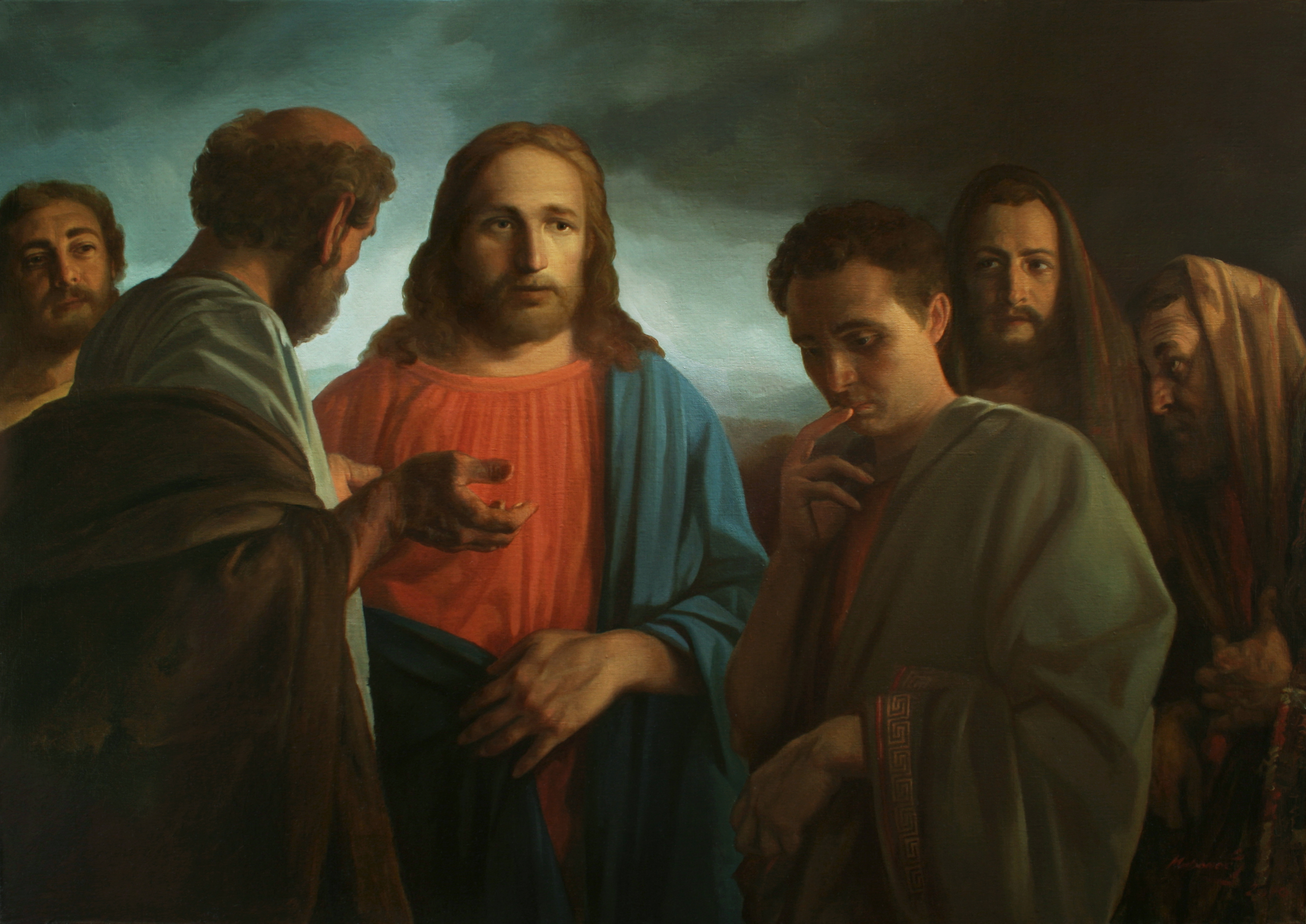
The painting of Christ with the rich young ruler reveals the angst-filled pathos of not having a clue when it comes to the destiny of our souls.  The young man asked the elephant-in-the-room question everyone else was thinking…uhhh, Jesus, what’s gonna happen to me in the long run…and what should I do about it?

The men surrounding Jesus are listening intently.  You can see skepticism, fascination, and true holding-your-breath-for-the-answer-honesty in their faces.  After all, you don’t throw-off the question of eternity like you’d discard a candy wrapper.  This was important…even a rich man, with the world at his disposal, couldn’t resist asking for insight on eternal life.

Jesus pointed the young man to what’s written in Scripture about obeying God’s commands, honesty, kindness, generosity, and so on.  But the young man pressed deeper, and Jesus obliged him, and went right for the underbelly of the issue; his answer was, quite pointedly:  What’s the most important thing you wouldn’t want to give up?  The answer welling-up in the young man’s soul made him sad, very sad!  How can you let go of what possesses you?

Peter, (to the left of Jesus in the painting) is standing there with hands unfolded in a questioning motion.  The artist, I believe, is giving Peter’s voice that hopeful edge, as he’s reminding Jesus how he and the other disciples left all they had to follow…was that enough?  Jesus’ answer isn’t a get-out-of-jail-free card, a Christian believer’s ID you can present at the pearly gates.  It’s more of a reminder that the final judgment on each of us is in God’s hands.  It is the Father who looks into each person’s heart and judges, repaying reward or punishment with absolute righteousness.

For You Today

The question the rich young man asked is not a bad one if you ask it with empty hands and open heart.  But a better question might be:  Lord, I have decided nothing I have belongs to me…what should I do with it; how can I follow you today?

You chew on that as you hit the Rocky Road; have a blessed day!

Go to VIDEO (read by author)

There are about 2,000 devotional posts and 400 sermons in the Rocky Road Devotions library.  To dig deeper on today’s topic, explore some of these: 

Unconvinced and More Than Enough

[1] Images:   WikimediaCommons - ©2010 Andrey Mironov   Unless noted, Scripture quoted from The New Living Translation©   

Wednesday, October 28, 2020

What Else?


Wednesday, October 28, 2020

Someone came to Jesus with this question:  “Teacher, what good deed must I do to have eternal life?”  “Why ask me about what is good?”  Jesus replied.  “There is only One who is good.  But to answer your question—if you want to receive eternal life, keep the commandments.”  “Which ones?” the man asked.  And Jesus replied:  “‘You must not murder.  You must not commit adultery.  You must not steal.  You must not testify falsely.  Honor your father and mother.  Love your neighbor as yourself.’”  “I’ve obeyed all these commandments,” the young man replied.  “What else must I do?”  Jesus told him, “If you want to be perfect, go and sell all your possessions and give the money to the poor, and you will have treasure in heaven.  Then come, follow me.”  But when the young man heard this, he went away sad, for he had many possessions.  Matthew 19:16-22

Matthew, Jesus’ tax collector – turned disciple/apostle, knew what it was to keep the scorecard.  He knew about adding up the debits and credits to balance the score.  If Matthew wasn’t telling his own story, it might as well have been his; he was a Jew collecting the Roman Emperor’s taxes from his fellow Jews.  Matthew knew what it was to have power, riches, and prominence.  He also knew what corruptive possibilities come with each, and the weight of being an outcast among your own people. 

This story was also recorded by Mark and Luke.[1]  It must have been hardest for Matthew to see this young man walk away from Jesus.  Knowing the allure of piling-up money to keep you free of the cares of everyday living costs, and the fear of returning to poverty, must have reminded the former mover and shaker of what used to be so important.  That was a stark reminder of what he used to be, and a powerful contrast to what he’d become.  The requirement of entering the surrendered life of following Jesus without reserve is no small thing.

Another, somewhat different take on the rich young man who chose his 401K over Jesus’ offer of eternal riches, is that he really wasn’t serious about the question he asked.  He may have been serious, but what if he was only looking for Jesus to sign his report card?  What if the young man was saying to Jesus, I’ve listened to your preaching these past several months, all that stuff about being perfect.  Look here at my life; I’ve not murdered, stolen, or told lies.  I take care of my parents who are aged and can’t support themselves.  What else?  What else do I have to do to be ‘good’ with God? 

But perhaps the man had listened to Jesus’ sermon on the mount (which Matthew also recorded[2]), and maybe it had somehow gotten in his head that he might have missed something.  That preacher/prophet had even said it loud and clear, those who followed him must be perfect, even as Jehovah in Heaven was perfect.[3]  The rich young ruler’s question may have been driven by sleepless nights, trying to convince himself that he was already a good man, having lived a moral life.  He’d always tried to do everything right.  What else?  Did I leave anything out? 

There is almost a passive anger about the question; who is this preacher, anyway?  He doesn’t know me; he has no idea the pressures I face every day.  I gotta talk to this guy; I’ll show him how I’ve lived a good life.  Surely that’s enough, even for God. 

And so, the young man did just that.  And the question came out, What else?  And then the answer came out…everything…everything that’s standing in your way of truly worshipping God…that’s what else!

Jesus knew the man’s net worth was what mattered most, and, therefore, the biggest obstacle to this man’s eternal life.  The doctor from Nazareth wrote the prescription, give away that which will eventually rust and rot and have no value…then bring the only eternal thing you really have and let me light it up with eternal life and joy.

Unfortunately, the rich young ruler, accustomed to wheeling and dealing in the financial big leagues couldn’t see the best opportunity he’d ever encountered.  

For You Today

The word for us today is…take Jesus at his word…it’s a sad thing to walk away from eternal life and joy for a little more of what this world thinks is best.  Lord, save us from having to ask the question, What else?

You chew on that as you hit the Rocky Road; have a blessed day!

GO TO VIDEO

Title image:  Pixabay.com   W   Unless noted, Scripture quoted from The New Living Translation©

For other posts on this text see:  I Can't Get No Satisfaction and Choosing


[3] But you are to be perfect, even as your Father in heaven is perfect.      Matthew 5:48


Tuesday, February 4, 2020

Measuring What's in the Basket

Tuesday, February 4, 2020

Now there was a wealthy and influential man in Bethlehem named Boaz, who was a relative of Naomi’s husband, Elimelech.  One day Ruth the Moabite said to Naomi, “Let me go out into the harvest fields to pick up the stalks of grain left behind by anyone who is kind enough to let me do it.”  Naomi replied, “All right, my daughter, go ahead.”  So Ruth went out to gather grain behind the harvesters.  And as it happened, she found herself working in a field that belonged to Boaz, the relative of her father-in-law, Elimelech.  While she was there, Boaz arrived from Bethlehem and greeted the harvesters.  “The Lord be with you!” he said.  “The Lord bless you!” the harvesters replied.  Then Boaz asked his foreman, “Who is that young woman over there?  Who does she belong to?”  And the foreman replied, “She is the young woman from Moab who came back with Naomi.  She asked me this morning if she could gather grain behind the harvesters.  She has been hard at work ever since, except for a few minutes’ rest in the shelter.”  Boaz went over and said to Ruth, “Listen, my daughter.  Stay right here with us when you gather grain; don’t go to any other fields.  Stay right behind the young women working in my field.  See which part of the field they are harvesting, and then follow them.  I have warned the young men not to treat you roughly.  And when you are thirsty, help yourself to the water they have drawn from the well.”  Ruth fell at his feet and thanked him warmly.  “What have I done to deserve such kindness?” she asked.  “I am only a foreigner.”  “Yes, I know,” Boaz replied.  “But I also know about everything you have done for your mother-in-law since the death of your husband.  I have heard how you left your father and mother and your own land to live here among complete strangers.  May the Lord, the God of Israel, under whose wings you have come to take refuge, reward you fully for what you have done.”  “I hope I continue to please you, sir,” she replied.  “You have comforted me by speaking so kindly to me, even though I am not one of your workers.”  At mealtime Boaz called to her, “Come over here, and help yourself to some food. You can dip your bread in the sour wine.”  So she sat with his harvesters, and Boaz gave her some roasted grain to eat.  She ate all she wanted and still had some left over.  When Ruth went back to work again, Boaz ordered his young men, “Let her gather grain right among the sheaves without stopping her.  And pull out some heads of barley from the bundles and drop them on purpose for her.  Let her pick them up, and don’t give her a hard time!”  Ruth 2:1-16

When it comes to wealthy and influential people, harvest time is for measuring how well they’ve done business.  But it is not only a matter of raking in the profits of a harvest, it’s also about the lives of all who are in any way connected to the process.  In the case of Boaz measuring what was in his baskets would take more than a reputable accounting firm; how do you measure kindness?
It’s indisputable that Boaz was a kind-hearted man.  Arriving in the middle of a workday in the harvest he greeted his workers with a blessing.  The fact that they greeted him with an equally warm blessing spoke volumes about the relationship the boss had with his laborers.  On top of this was the fact that Boaz considered the welfare of Ruth, a foreigner who was gleaning.  In that culture the poor were permitted to come behind the work crews to pick up whatever harvest scraps the workers missed.  A greedy heart in Boaz’ basket might have treated Ruth like a freeloading nuisance.  Boaz treated her like part of the family, even calling her “daughter”.  He made room for this daughter of Moab, not part of his clan, perhaps as a kindness to his relative Elimelech, Naomi’s deceased husband. 
Of course, having read the rest of Ruth’s story, and the story of generations that followed, we can also see in Boaz’ harvest baskets the preservation of God’s promises to not only Israel, but all humanity.  God had promised a Messiah, a deliverer, one who would save us from our sins.  Ruth was part of that plan.  In the lineage of Boaz and Ruth Jesus would one day bless eternity with blood that cleanses all who will trust.
For You Today
You chew on that as you hit the Rocky Road; have a blessed day!

Go to VIDEO


[1] Title Image:   Pixabay.com    Unless noted, Scripture quoted from The New Living Translation©

Thursday, August 15, 2019

James the Just - Part 4 - Advice to Both the Rich and Poor

Friday, August 16, 2019

Believers who are poor have something to boast about, for God has honored them.  And those who are rich should boast that God has humbled them.  They will fade away like a little flower in the field.  The hot sun rises and the grass withers; the little flower droops and falls, and its beauty fades away.  In the same way, the rich will fade away with all of their achievements.  James 1:9-11

I have never been in danger of being included on the Forbes List of the richest people anywhere.  I was stationed at Fort Knox for the last six months of Army service, but I never even saw the gold (they never let you get too close!). 
On the other side of that coin I was born a citizen of the United States of America; that immediately placed me in a category of wealth compared to most of the world’s people.  Being a rich person is always relative based upon to whom you’re being compared.  Compare my bank account to a homeless man, and it appears I struck the mother lode; re-focus the comparison to Donald Trump or Warren Buffet, and that contest is a joke.
James says the poor are honored by God.  In our culture, with its emphasis on owning stuff and building a life on the stuff you can acquire, that is a startling statement.  But, startling statements are nothing new when you’re turning the pages of Holy Scripture. 
James started off his epistle talking about faith being tested with tough times, and he’s elaborating here on the wise exercise of faith.  The apostle says acting in faith means making decisions which affirm the fact that my relationship with God defines the meaning of my life, not the size of my portfolio.  Jesus nailed that down neatly for us:

Then he said, “Beware! Guard against every kind of greed. Life is not measured by how much you own.”   Then he told them a story:  “A rich man had a fertile farm that produced fine crops.  He said to himself, ‘What should I do?  I don’t have room for all my crops.’  Then he said, ‘I know! I’ll tear down my barns and build bigger ones.  Then I’ll have room enough to store all my wheat and other goods.  And I’ll sit back and say to myself, “My friend, you have enough stored away for years to come.  Now take it easy! Eat, drink, and be merry!”’  “But God said to him, ‘You fool!  You will die this very night.  Then who will get everything you worked for?’  “Yes, a person is a fool to store up earthly wealth but not have a rich relationship with God.”  Luke 12:15-21

Besides building bigger barns, rich and poor alike have always tried to build bigger monuments to what they have done in life.  This, if you believe Solomon, is also vanity, or emptiness.  James says the achievements of which we boast will fade like our hairlines, waistlines, and lifelines.  I have read the stories of many rich people in history, including Hughes, Rockefeller, Gates, Jobs, Onassis, Kennedy, and even King Solomon.  Ultimately it is not the balance sheet that impresses me about any of them, but rather the faith that connects creature with Creator, and how it impacted what they did. 
Jesus didn’t own a thing.  Even the robe he wore got repossessed and became the prize in a dice game.  Jesus’ true legacy shows up in the hearts and decisions of millions of believers every day. 
For You Today
If you were the rich guy in Jesus’ story, would you have the wisdom James talks about to change the ending of that story?  And would you?
You chew on that as you hit the Rocky Road; have a blessed day.

Go to VIDEO


[1] Title Image:  Courtesy of  Wikimedia Commons
                          Unless otherwise noted, Scripture used from The New Living Translation©